Still, the first sign of trust was never applause. It was a person pausing long enough to ask a real question and then waiting for the answer. Noah did not need electrician Camille Brooks to call him a genius. He needed a chance to show the difference between what he had seen and what he only suspected.
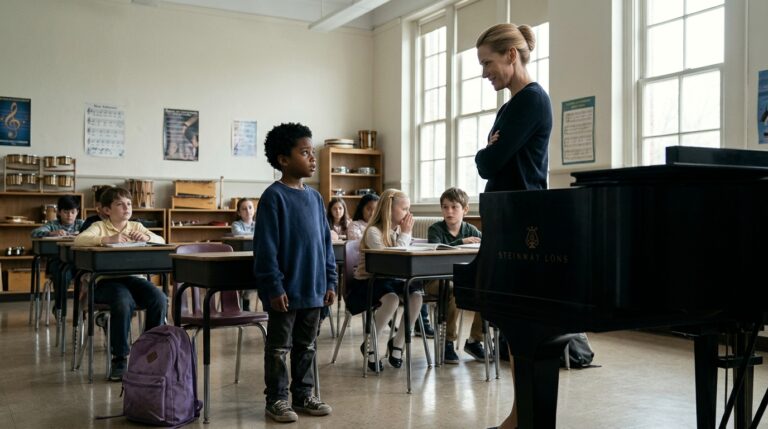
Mrs. Grant asked the class to draw a map of a model fairground using colored paper instead of real wiring. Each team had to place booths, emergency exits, and pretend light sources. Noah discovered that students who could not name a switch or fuse were good at seeing where a family might become confused in the dark.
One girl pointed out that the model had no information for visitors who used wheelchairs. Another asked where a frightened child would find help. The project grew beyond Noah’s first diagram. He began to understand that safe public events involved communication and planning as well as equipment.
Erin attended the class presentation after finishing a morning shift. She saw Noah listening to other students instead of trying to prove he knew more than they did. Mrs. Grant asked whether he would help build a reusable teaching board for next year’s fair safety week. He agreed if everyone who contributed had their name on it.
The school principal said the project sounded promising but the materials budget was nearly empty.
—
Noah did not ask for expensive electronics. He suggested a tabletop map using cardboard, colored lights powered by safe classroom batteries, and removable booth cards. Grandpa Wade volunteered to inspect the model before students used it. Mrs. Grant wrote a request for donated supplies, and a local hardware store offered materials left over from its holiday display.
Something shifted in Erin when another adult finally listened to her son without talking over him. Pride came first, then worry. She knew how easily an eager child could be invited to carry the blame if a hurried repair went wrong. She wanted the work inspected properly, every step documented, and credit shared with whoever actually did it. He would have to keep learning.
The first model was too crowded. Students placed all the emergency information in one corner, making the opposite side appear empty and confusing. Noah wanted to start over. A classmate suggested walking a toy figure from each booth to the nearest safe exit. The simple test revealed problems the team had missed.
Wade asked the students why a diagram could be correct in one situation and misleading after someone moved a booth. Noah remembered the unrecorded trailers. He added a reminder to update the model whenever the layout changed, not merely when a lamp failed. Erin smiled because the lesson had become useful outside the classroom.