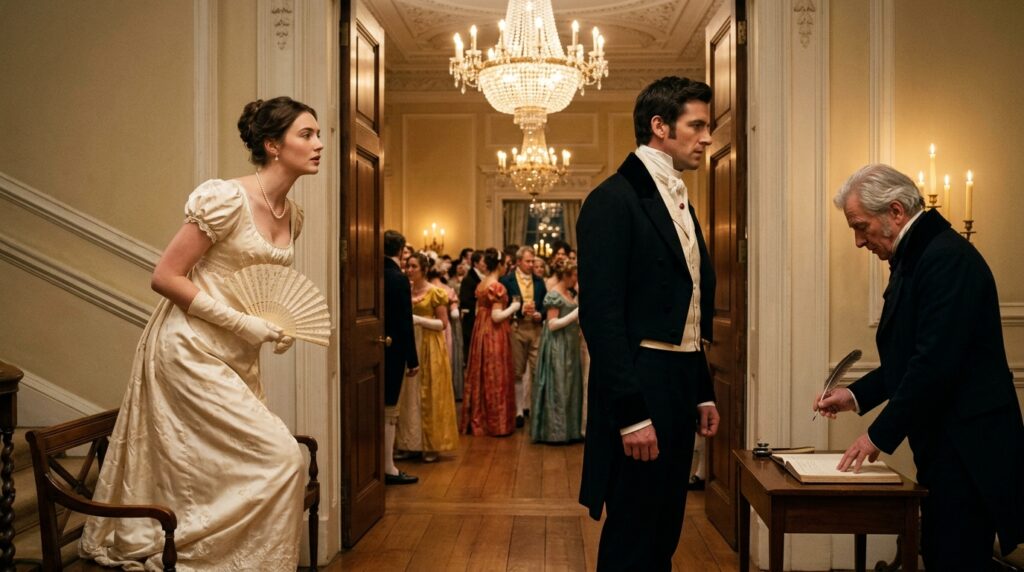
The tall gentleman at the top of the assembly room stairs had been asked his name, and he did not give it. The master of ceremonies waited with his pen over the book. Behind the double doors, the fiddles had begun, and the long room was full of people who had come to look at one particular man. The gentleman stood straight in a black coat finer than any in that town, and his mouth stayed shut.
On the bench by the stair head sat a very tall young woman in cream silk with an old ivory fan in her lap. She had been waiting an hour for a man she had never seen. She looked at the stranger’s height and his fine coat and the way he stood as if the whole room were about to turn round and stare at him. Then she got up.
“Never mind his name,” she said, and put her hand through his arm. “He’s with me. My aunt engaged him for the evening.”
She had to look up at him, which she was not used to doing with any man.
“You’re Mr. Hollis,” she said. “You’re very late. Aunt said you’d be tall. She didn’t say you’d look so frightened.”
He looked down at the ivory fan in her hand. He could have told her who he was in one sentence.
“I’m sorry to have kept you waiting, ma’am.”
She had mistaken the duke for the escort her aunt had hired, and he played the part all night and never told her. She turned him toward the doors and spoke low and quick as she always did when she was frightened.
“You’ll take me in and stand up with me for the first two dances and look as if you like it. You needn’t talk. Aunt says you’re shy. And don’t stare at the door all evening. They’re all waiting for the duke.”
“Yes, ma’am.”
The master of ceremonies looked from one of them to the other and wrote nothing in his book. It was Thursday, the 26th of June, 1817, and the June assembly was fuller than anybody could remember. They went in on her arm through the double doors. All down the long room, heads turned at the stranger’s coat, and then turned back to the door behind him, because he was not the man they were waiting for.
“There,” she said, “nobody’s looking at you now. It’s the best thing about this town.”
“Is it?”
“Very nearly the only thing.”
The first set was forming. He led her up the room, past the fireplace where the patronesses sat, toward the head of the line. She stopped dead.
“Not the top. I don’t stand at the top.”
He did not ask why. He took her all the way down to the bottom of the set, below the last of the three tall windows, and her hand on his sleeve grew a little easier. For eight years she had sat on the bench by the wall at every assembly in that room. Tonight, she had crossed the stairhead and answered for a stranger, because she knew exactly what a man looked like when a room was about to look at him.
Then the fiddles struck up, and she danced. She went through the figures the way some women sing, without thinking. She went down the set and back up it, very straight and very light for so tall a girl. Nobody in that room had seen it for eight years.
“You dance very well,” he said when the figure brought them together.
He did not know what to call her.
“Ashdown,” she said. “Aunt will have told you, and you’re not meant to talk.”
“So I’m not.”
Her name was Hannah Ashdown. She was 25 years old, and the only time a man had ever led her to the top of a set in that room, he had walked away from her before the music began. That night, she gave a duke his orders as if he were a hired man, and he obeyed every one. Before the summer was out, he would come up those stairs again and give the whole room his name.











