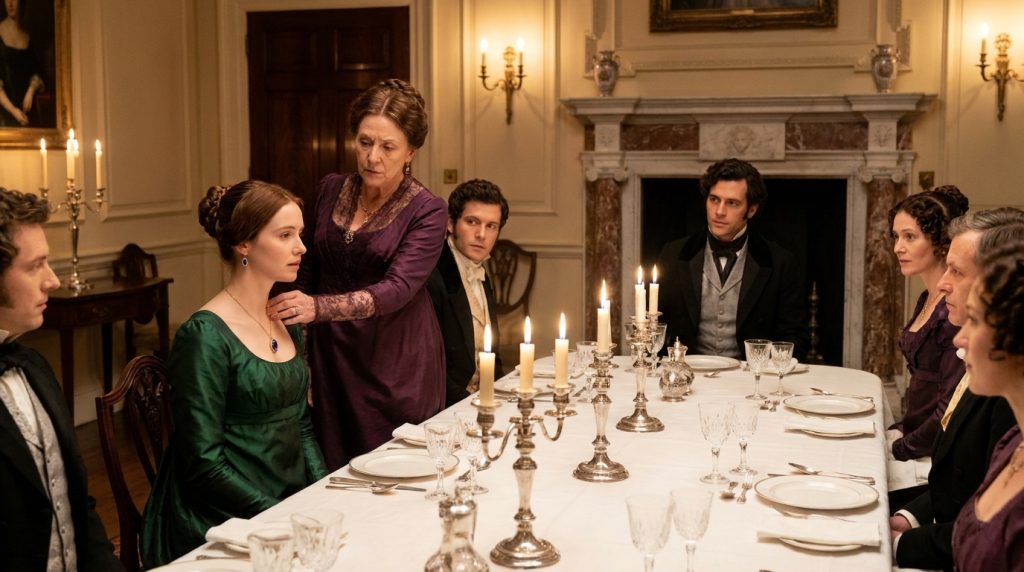
“And, of course, we must not forget our dear Eleanor,” Lady Victoria Crane said, raising her glass of red wine until the candlelight turned it ruby. “Eight and twenty, and still unmarried. I fear we have almost given up hope. But she is very useful with the household accounts, and the parish children adore her, so one must be grateful for what one has.”
On an autumn evening in 1820, the long dinner table at Crane Park fell quiet for a moment. Then came the sort of laughter that follows a hostess’s joke when everyone wishes to show how much they appreciate it. Mrs. Pomfrey giggled behind her fan. Sir Gerald Hollis gave a short, decisive bark. Young Clarissa Crane, nineteen, newly engaged, and dressed in white silk embroidered with silver, laughed loudest, leaning toward her fiancé, Mr. Edmund Fairley, to whisper something that made him laugh too.
Below the salt, Miss Eleanor Whitmore looked down at her plate and smiled. She wore a simple pale-blue empire-waist gown that she had altered and mended twice. Her chestnut-brown hair was pinned in a modest bun, and her hazel-green eyes remained lowered. At her throat lay a delicate antique gold necklace, its distinctive blue sapphire pendant catching the warm light.
Her smile was one she had perfected over twelve years. It said that she was not hurt, that she understood this was the price of her place at the table, and that she wished everyone would please move on. She had heard her aunt make such remarks a hundred times: in drawing rooms, at church, in village shops.
“She is a good, sensible girl, but of course there is no fortune. Past her bloom, poor thing. She will make some elderly widower a very practical companion one day.”
Eleanor had long ago learned that the only way to survive such observations was to let them pass like wind through an open window. She lifted her fork and waited for the laughter to subside. Lady Victoria, however, had risen from her place and was standing directly beside Eleanor’s chair. At fifty-three, with sharp gray eyes, dark auburn curls, diamond earrings, and an extravagant burgundy silk gown, she knew how to command a room. Her gaze dropped to the sapphire.
Before Eleanor could move, her aunt caught the necklace and pulled it sharply away. The clasp sprang open. The entire chain came free into Lady Victoria’s hand, leaving Eleanor’s neckline unchanged and her throat bare. Eleanor recoiled and instinctively raised a hand to her neck.
“You have no right to wear our family jewels!” Lady Victoria said.
She lifted the necklace for the table to see. The sapphire swung beneath her fingers, brilliant against the burgundy silk. Eleanor stared at it, devastated, her lips trembling. She reached toward it, then stopped.
“Please… that necklace was given to me.”
Her aunt laughed contemptuously. About two meters away sat the most important guest Crane Park had received in a generation: Alexander Thorne, Duke of Westbrook. He had come into the county only two weeks earlier to take possession of Westbrook Abbey. He was thirty-six, tall and handsome, with dark, wavy hair, steel-blue eyes, the straight shoulders of a soldier, and a quiet, watchful face. He wore a black tailcoat, an ivory waistcoat, and a white cravat. Every mother in the county with an unmarried daughter had sent an invitation. Lady Victoria’s had been the first he accepted.