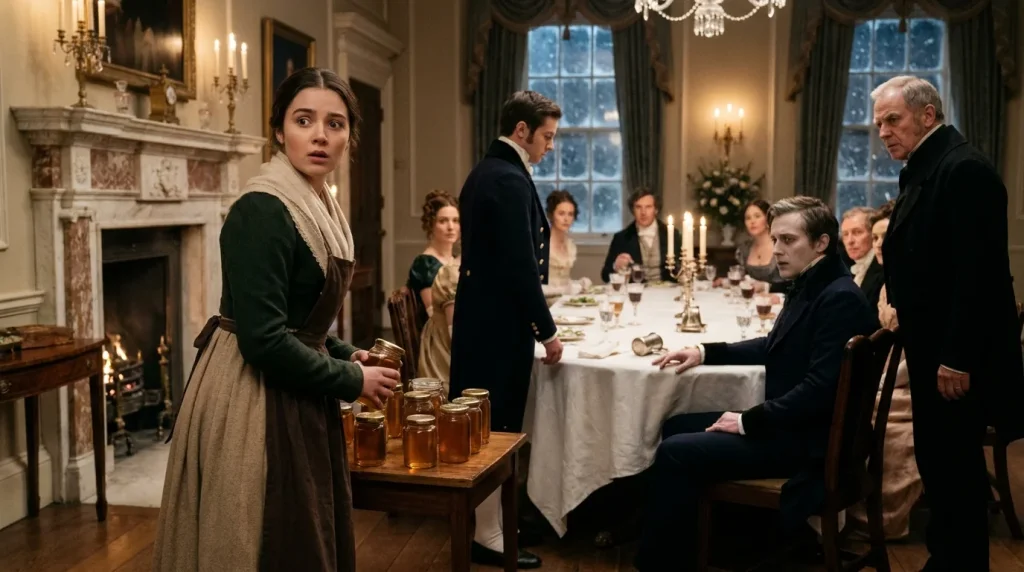
Frostmere Hall was buried in snow on the longest night of the year, and in the middle of the winter banquet, Duke Adrian Blackwood collapsed over his plate. His lips turned purple. His fingers trembled against the white linen, and not a single person stood up. The nobles thought he was drunk. The physician called it exhaustion. The servants lowered their eyes, afraid to breach the rules of the table.
In that glittering hall, only one person saw what everyone else ignored, and she was a village girl who had come to sell honey.
“He has been poisoned,” she said.
No one believed her. So Eliza Hart pushed a footman aside, seized the dying Duke, and hoisted him over her shoulder while the room erupted in cries. But as snow sealed every road out of Frostmere, Eliza realized something far worse. Whoever had poisoned the Duke was still inside the house.
Outside, the winter night was merciless. Snow fell thick and heavy over the northern hills, and the wind battered the hall’s tall windows as though something were trying to get in. Inside, golden light shone over long tables crowded with the most distinguished families in the county, gathered for the winter solstice feast. The air smelled of mulled wine, warm honey, cinnamon, and oranges studded with cloves. Velvet skirts brushed the floor, and silver platters of roast goose and sugared pears passed from hand to hand. Laughter rose toward the painted ceiling and drifted down again like warm smoke.
At the head of the central table sat the man who owned the house. He was dying. Duke Adrian Blackwood had not moved for several minutes. His face was ashen. His dark eyes stared at nothing, their focus slipping away like water through fingers. A silver cup lay on its side beside his hand, a thin stream of spiced wine soaking into the tablecloth.
He was thirty-two, tall and broad-shouldered, the most powerful man in three counties. At that moment, he could no longer feel his own fingertips. Lady Evelyn Vane, seated two places away, stirred her fan and leaned toward her neighbor.
“His Grace has been generous with the wine tonight,” she whispered.
Her neighbor laughed. Across the table, Sir Jasper Whitlock raised his glass in a mocking toast to the Duke’s silence. At last Dr. Alistair Crowe, the family physician, sighed wearily and stood. He pressed two fingers to Adrian’s wrist and held them there for a moment.
“Heat and fatigue,” he announced, as though giving a report on the weather. “The room is too warm. He requires rest, nothing more.”
The guests nodded in relief and returned to their plates. At the far end of the hall, beside a small table near the servants’ door, stood a young woman in a plain, oatmeal-colored wool dress. Eliza Hart had arrived that afternoon from the village of Snowmere with a cart full of winter honey: pale golden jars sealed with wax and twine. She had not been invited as a guest. She had been given permission to sell. No one in the room knew her name.