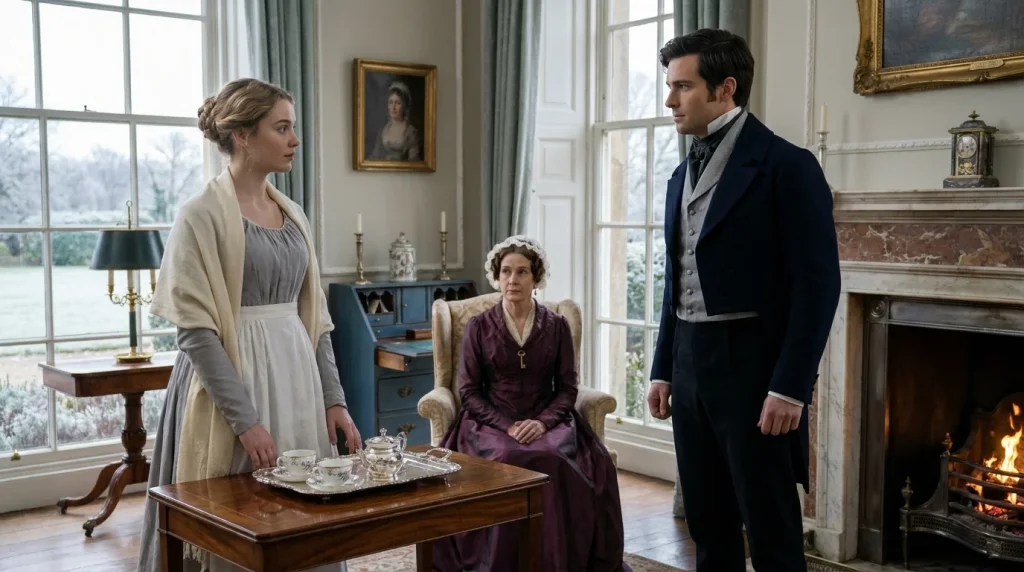
In the small drawing room at Heather Hall stood a blue writing cabinet that only the Dowager Duchess was permitted to touch. It was painted the color of a winter sky, and its little brass key hung on a ribbon around her neck, day and night, like a widow’s necklace. The servants dusted around it. The maids lowered their voices near it. And every evening at nine, when the house had grown quiet, the Dowager Duchess Adelaide sat alone before it, opened it, and did not close it again for an hour.
On the last Sunday of October in 1824, her son found her there. Rain lashed the tall windows, and the fire was burning low. Sebastian Heathersett, fourth Duke of Heather, stood in the doorway with a letter in his hand. For a moment he merely watched her: her straight back, her silver hair, her fingers resting on a folded page she was not reading. Then he came in and laid his letter on the table beside her.
“Lord Henry Dunstable has written again. He is bringing his daughter to dinner on Thursday. He wishes to know, very politely, whether I intend to offer for her before Christmas, or whether he should look elsewhere.”
The Dowager did not turn.
“Lady Lavinia is a sensible young woman,” she said. “Intelligent. Well read. She would not trouble you.”
“No. I do not suppose she would.”
He stood beside the fireplace with one hand on the mantel.
“I shall write to him tonight, Mother. I shall tell him not to waste his daughter’s season on me.”
“Sebastian, you are two and thirty. There is the title, the estate, and your sister’s future to consider. The people of four parishes depend upon this house continuing after you are gone.”
“Then my cousin in Bath may continue it. He has five sons and nothing better to do with them.”
At last she looked at him.
“And what will you do with yourself? Grow old in this house with me?”
He was silent for a long time. When he spoke again, his voice was low and level, the voice of a man who had decided something long ago and was only now finding occasion to say it.
“I shall never marry.”
The rain filled the silence.
“I watched you for twenty years,” he continued. “I watched my father bow to you at breakfast and dinner, and inquire after your health as though you were a neighbor he was obliged to visit. I have watched you sit beside that cabinet every night since he died. And I have never seen you happy. That is what marriage is, Mother. It begins with feeling. Then duty eats the feeling away, and what remains is two people being civil to one another until one of them is buried. I will not do that to a woman. I will not do it to myself.”
Her hand closed over the folded page. For an instant, something urgent crossed her face, as though a great many words were waiting behind her lips.
“Your father,” she began, and stopped.
“Do not defend him.”
“I was not going to,” she said quietly.
Then she turned back to the cabinet, and he understood that he had been dismissed. He left her there. He did not see her rest her forehead against the cool blue wood, or hear what she whispered to it. Nor did he think of the new lady’s maid his mother’s solicitor had engaged, who was to arrive the following morning.
She came at ten on the coach from Norwich, through the last of the rain: a young woman of about twenty in a gray pelisse that had once been good and was now merely clean. She had one small trunk and an old writing box of polished walnut. She carried the writing box herself and would not let the groom take it. Her name was Damaris Quenby.