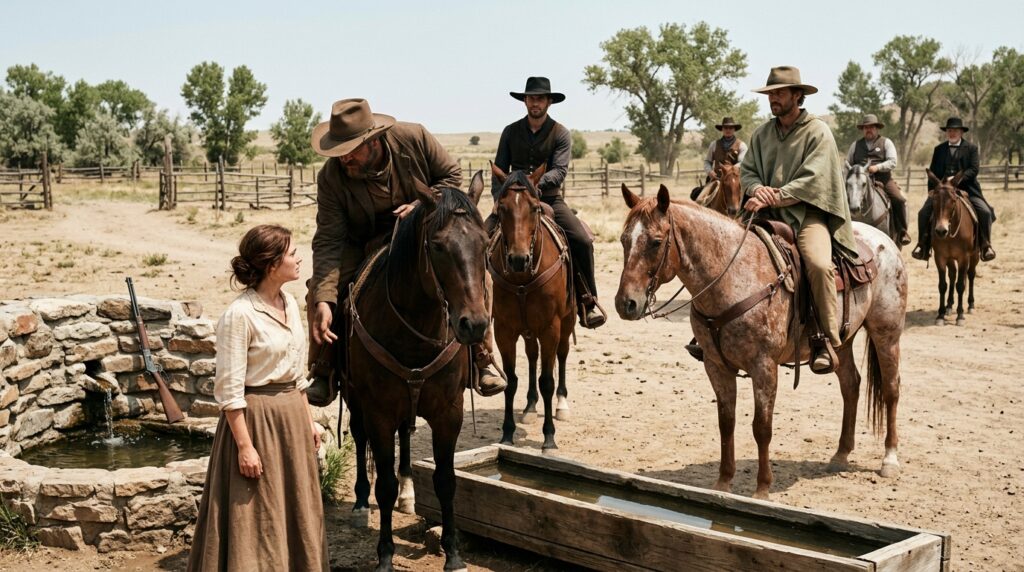
Three words. That’s all it took. And every man standing in that yard that morning would spend the rest of his life reckoning with what followed. I was there, friend. Leaning against a cottonwood not 40 yards from the Whitmore spring, and I watched every bit of it unfold. Watched those riders spread out around a young woman who hadn’t wronged a single soul.
Watched the sheriff tip his hat like he was attending a picnic instead of a shakedown. Watched the preacher clasp his hands and find something very interesting to study in the dirt at his feet. And I watched the man in the sun-bleached poncho, lean somewhere around 30, trail dust worked into every crease of his clothes, riding a red roan mare who was long overdue for water. He came in slow. Took one look at what was happening, and said it again:
“Leave her alone.”
They left. That was the worst decision they ever made. Her name was Clara Whitmore. And the spring on her land, sitting cool and constant in Haskell County, New Mexico Territory, in the scorching August of 1883, was the only reliable water source for 50 miles in any direction. Her father, old Thomas Whitmore, had understood that spring the way a chess player understands a queen.
It was the piece that made everything else matter. His cattle drank when others were hauling from dry creek beds. His neighbors always seemed to owe him something. He’d built his whole operation around that cold, patient fact. He died in June without any warning.
Heart gave out somewhere between breakfast and noon. And left the ranch to his daughter and whatever stubbornness she’d inherited from him. She had plenty. What Clara didn’t know yet, couldn’t have known, was that the quiet, dusty stranger who’d just ridden in from the south carried a history that would have changed the temperature of that whole encounter if any of those men had recognized him. They were about to find out the hard way.
Now, let’s go back. Back to that August morning. Back to the spring. Thomas Whitmore had built the Rocking W out of nothing but labor and refusal to quit. 30 years working Haskell County ground, hauling water and mending wire, losing cattle to hard winters and bad luck, and somewhere in the middle of it all finding that spring.
A cold, dependable seep that opened into a rock basin the size of a wagon bed and had never gone dry. Not through the worst droughts the territory could produce. He’d cleared it out, lined it with flat stone, built a catch trough. To him it wasn’t just water. It was the reason the whole operation held together.
He had one child, Clara. She’d grown up riding beside him, reading his ledgers by lantern light, learning every acre of that land by instinct and repetition. She was 23 when he died. Dark-haired, gray-eyed like her father, with a temper she kept on a tight rein most of the time. She wasn’t a fragile person, but she was alone on a ranch that suddenly had a great many men paying it very close attention.











