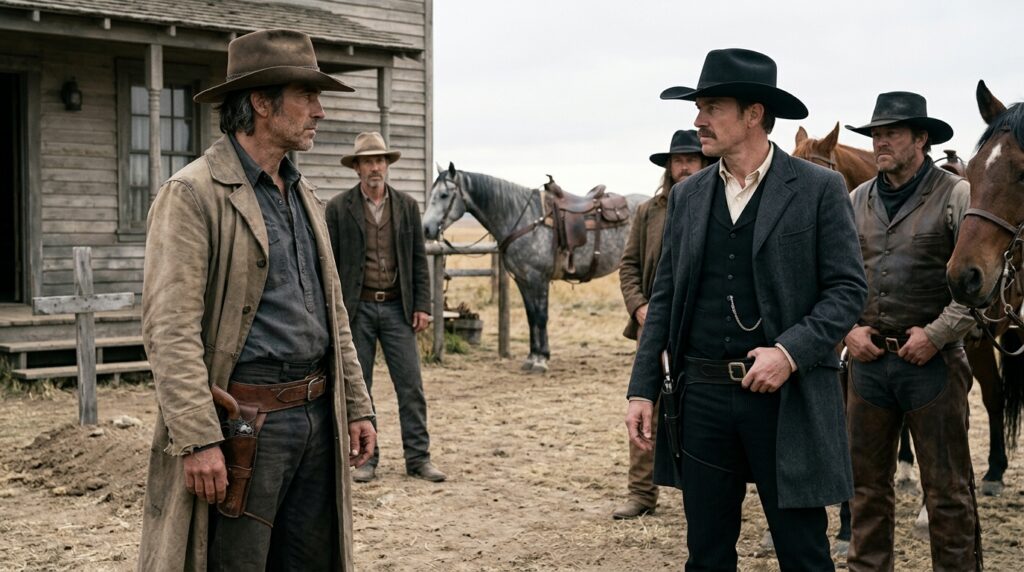
A single shot cracked across the yard, and the rancher’s wife crumpled against her own porch rail while her husband, held at gunpoint by two other men, screamed a name the whole valley would carry for years afterward.
“Should have signed when I asked the first time, Ezra. Now every family in Milk Creek knows exactly what happens when they don’t.”
The stranger, passing along the ridge road above the homestead with no more urgent business than reaching the next settlement by nightfall, stopped his horse at the sound of the shot.
“That’s the last shot you’ll ever fire in this valley.”
What happened over the following 5 days would end Rosco Dayne’s grip on Milk Creek for good, and it would end an operation built on considerably more graves than the one that valley would ever officially count. But to understand why a single shot fired at a ranch wife’s porch became the worst mistake Rosco Dayne ever made, you have to understand exactly what kind of man he’d already become, and exactly how much of that valley he’d already decided belonged to him before anyone found the courage to argue otherwise.
Milk Creek sat in a well-watered stretch of the Montana Territory in the autumn of 1886, prized among cattlemen for grazing land that held its grass considerably longer into the season than the drier country surrounding it. Rosco Dayne had arrived there 3 years earlier with borrowed capital and a small herd, and had discovered within his first season exactly what every ambitious man before him eventually discovers about a valley full of decent, trusting people: that decency made poor defense against a man willing to go further than his neighbors could imagine. Dayne did not build his empire through honest negotiation. He built it through a slow, patient campaign of fires that started too conveniently near property lines, wells that turned foul the same week a rancher refused an offer, and, when those methods failed to move a particularly stubborn holdout, something considerably more permanent.
He kept five hired men on his payroll for exactly this purpose, chief among them a broad, silent enforcer named Otis Gryom, whose particular talent lay in making violence look on the surface like nothing more than a frontier’s ordinary run of bad luck. Dayne was 44 years old, weathered and precisely controlled, with the particular cold patience of a man who understood that a slow campaign of accumulated fear accomplished more over time than any single dramatic act of violence ever could. He rarely handled his own dirty work, preferring to let Gryom and the others carry out whatever escalation a stubborn holdout eventually required, keeping his own hands, in his own private accounting, considerably cleaner than the ledger of ruined families his operation had actually produced. By the autumn of 1886, only one rancher in Milk Creek still refused outright to sell his land to Dayne’s operation: a man named Ezra Colt, who had built his modest spread with his own hands over 15 years, married a woman named Sarah two winters after arriving, and raised in the years since exactly the kind of quiet, stubborn independence that made him considerably more of a problem to Dayne than any of the other holdouts, who had one by one eventually accepted Dayne’s terms rather than risk what continued resistance might cost them.











