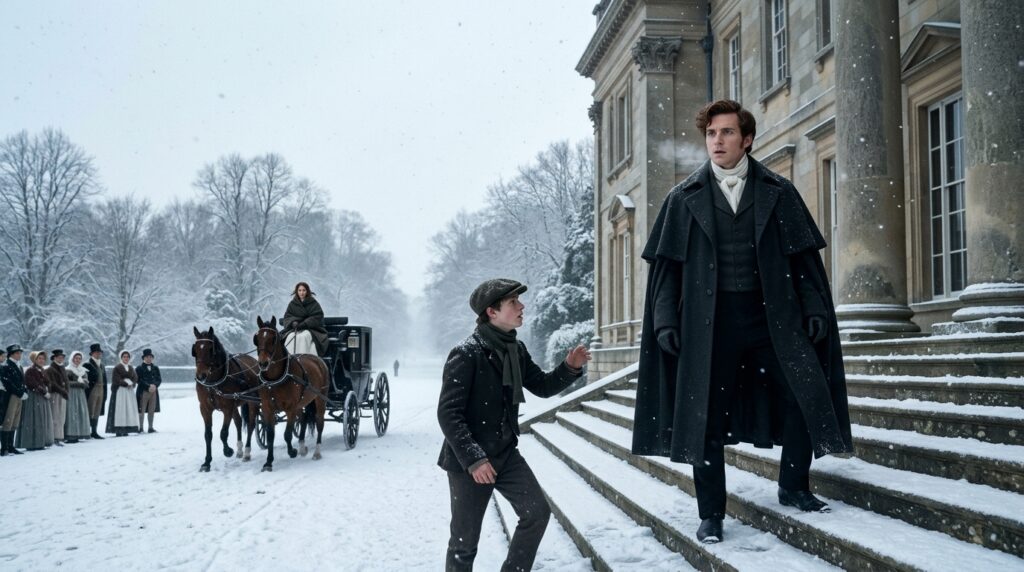
She had been asking it for two months. Cresa had a beautiful daughter and the proudest heart in Oxfordshire. A duke had come onto the board. And Cresa, who would have walked to London barefoot to see her own child, a duchess, had handed the prize to her stepdaughter, and smiled while she did it. It made no sense.
A good player does not give up her best square for nothing, and Cresa was a very good player. The Iron Park carriage had come for her at 11 that morning, and it had been the finest thing ever seen at the Hythe. Cresa came as far as the door to see her off, though not as far as the step, where the wind might have disarranged her. She was 48 and still handsome, and she stood as if a portrait were being taken.
“You will do very well, my dear,” she said, and kissed the air beside Juliet’s ear. “Nobody will expect a thing of you. There is such freedom in that.”
It had not occurred to anybody to send a maid, since one would no doubt be found for her at Iron Park. Charlotte lifted an uncertain hand at an upstairs window. Her father did not come up from the wharf at all, but stood with his back to the house in the wind, looking very hard at a barge that did not need looking at. The straightway to Iron Park ran across the meadows by the old causeway, and she had driven it herself the day before.
Old Mr. Bray said it was bad after the rain, and he took the long way round by the Reading road, with a stable lad called Davey hanging on behind. Juliet sat alone in all that dark blue cloth with the folding board on her knee. And she had not gone four miles when the carriage turned in under the sign of the Bell. It was a low old inn in a river village with a yard full of wet straw.
“To bait the horses, Miss,” said Mr. Bray at the window, and he did not look at her.
The horses had hardly warmed. She looked at the old man’s back as he went in through the side door without stopping to speak to anybody. Like a man who has gone in by that door a great many times. Nobody moves a piece for no reason. The landlady came out with a shawl over her head, a broad woman, past 60, with a bargeman’s forearms, and she looked Juliet up and down as if she might be thinking of buying her.
“So, you’re what all the fuss is about,” she said. “I’m Susan Bray, that was. That’s my brother you’ve got up there on your box and he’s 73 and he’s got no business on it in this wind. But you might as well tell the river to lie down. You’re perished. Come into the fire.”
It was a good fire. But the best part of an hour went by and the rain began and the landlady was called away to a carter. Juliet had seen something as she crossed that yard. At an upper window at the back of the house, a woman in gray had been standing a little behind the glass. She had been looking down at Juliet with a stillness that was not like a stranger’s curiosity.











