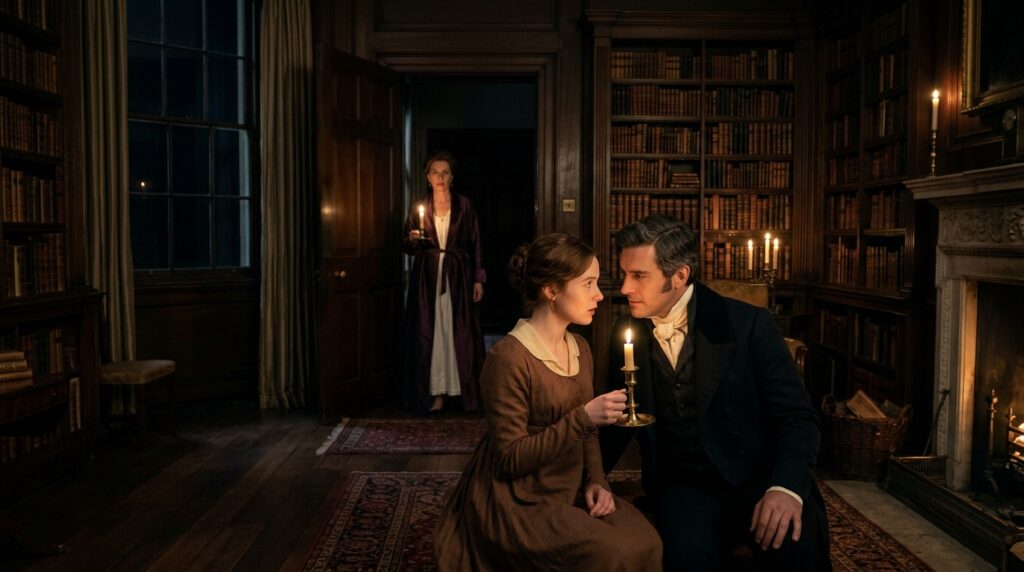
“She seems quite lost in thought. Perhaps she’s waiting for a dance.”
There are some women who enter a room and are seen at once. And there are others who enter a room, rearrange the cushions, mend the fire, find the lost spectacles, and leave again, and no one can quite remember afterwards whether they were there at all.
Hester Larkin was the second kind. And on the October evening this story begins, she was sitting in the window seat of Marchbank House, hemming her cousin’s petticoat, while her aunt read aloud a letter that would change her life. It was an invitation written on heavy cream paper with a ducal crest. The dowager, Duchess of Halsingham, requested the pleasure of Lady Marchbank’s company at Halsingham Park for the three weeks between Michaelmas and Harvest Sunday.
And at the bottom, the dowager had added one more line. Would Lady Marchbank kindly bring two young ladies of her household because her son at long last had agreed to look about him for a wife? Lady Deline Marchbank set the letter down. Her daughter Arabella, who was 19 and golden and had been told every day of her life that she was lovely, clapped her hands.
“Two young ladies,” said Lady Marchbank. “But we have only Arabella.”
Then her eyes traveled slowly across the room, past the fire, past the tea things, and came to rest on the window seat.
“Oh, mama,” said Arabella, beginning to giggle. “Not Hester.”
“Why not?”
Her mother’s smile spread like cream on a cat.
“Send the plain one. He’ll reject her in an hour. And standing next to her, my darling, you will look like the sunrise.”
They laughed. Even Sir Giles by the fire made a small uncomfortable sound that might have been a laugh. And then hid behind his newspaper.
Hester did not laugh. She was 28 years old. She had been a poor relation in this house for 6 years. She knew perfectly well what she was for.
She bent her head and went on sewing and she said only yes and in 3 weeks the whole of Shropshire would be talking about how the proud Duke of Halsingham could not take his eyes off the plain Miss Larkin. They would call it a mystery. Some would call it a scandal. Only Hester would know the truth and the truth would very nearly break her heart before it mended it.
Hester had not always been invisible. When she was a little girl, she had been the most important person in the world to exactly one man. Her grandfather, the Reverend Josiah Larkin, vicar of a small parish in the Welsh Hills, had raised her after her parents died of a fever when she was five, and her grandfather was blind. He had lost his sight slowly in his 50s, and by the time Hester came to live with him, the world was nothing but light and shadow to him.
So Hester became his eyes. She read him his sermons, his newspapers, his letters from the bishop. She walked beside him to church, counting the steps aloud. And every evening on the bench outside the vicarage door, he would say:











