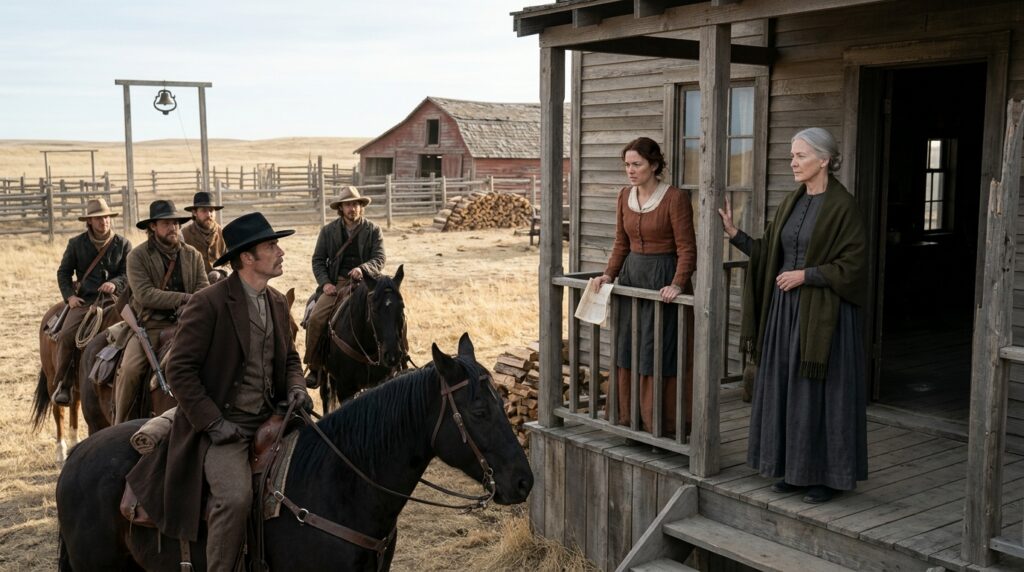
A Young Gunman Mocked the Old Woman Standing Beside Her Daughter — Until She Raised Her Rifle and Revealed Why Men Feared Her Name
The riders arrived just before sundown, when the last light lay across the Montana grass like a sheet of copper. They stopped in front of the Bellweather house, seven men mounted and armed, their horses blowing dust against the porch steps. At the doorway stood Nora Bellweather, twenty-eight, with a ledger pressed against her chest. Beside her was her mother, Eleanor Vale, a silver-haired woman in a plain black dress. The youngest rider laughed when he saw Eleanor. “That your protection, Nora? A grandmother with a broom?” His companions joined in. Nora felt the old fear rise, but Eleanor did not look away. She studied the men, then the distance between the porch and the hitching post. “You have come to take a house that is not yours,” she said. The rider in the expensive coat introduced himself as Harlan Pike, agent for the Granite Crown Land Company. He held out a paper bearing a red seal. “The debt is overdue. You have until tomorrow morning.”
Nora knew the debt was false. Her late husband had paid the county tax before he died. Pike knew it too, or he would not have brought armed men. Eleanor asked him to read the document aloud. He refused. The youngest rider leaned from his saddle and called her an old fool. Eleanor’s hand moved beneath her shawl. The laughter stopped when she brought out a long-barreled rifle and rested its stock against her shoulder.
The porch boards creaked beneath their weight, and Nora noticed that the youngest rider kept glancing at the house rather than at Eleanor. He was waiting for someone else to make the first move. The wind shifted.
“Before you decide what happens tomorrow,” she said, “you should learn what happened the last time men mistook my age for weakness.”
Three weeks earlier, Nora had been trying to keep the Bellweather freight station alive with two hired hands and a stubborn team of mules. Her husband, Samuel, had died in a wagon accident on the pass, leaving her the station, a small house, and a narrow strip of land beside the only reliable spring for miles. The company had offered to buy the property twice. Samuel refused because families traveling west depended on that water. After his funeral, the offers became threats. A surveyor appeared without permission. Fence posts were moved. A notice arrived claiming unpaid taxes, though Nora had a stamped receipt in Samuel’s desk. Sheriff Amos Rusk told her the county books were confused and advised her to accept Pike’s offer. When she asked him to investigate, he said a widow should not make enemies she could not afford. Nora had not told her mother how bad things had become. Eleanor lived forty miles away in a boardinghouse near Helena, and the two women had spent years speaking only at Christmas. Their distance began after Nora married Samuel against Eleanor’s wishes. Now Nora wrote a letter that contained no apology and no explanation. It said only that men were trying to take the spring, and that she needed someone she could trust.











