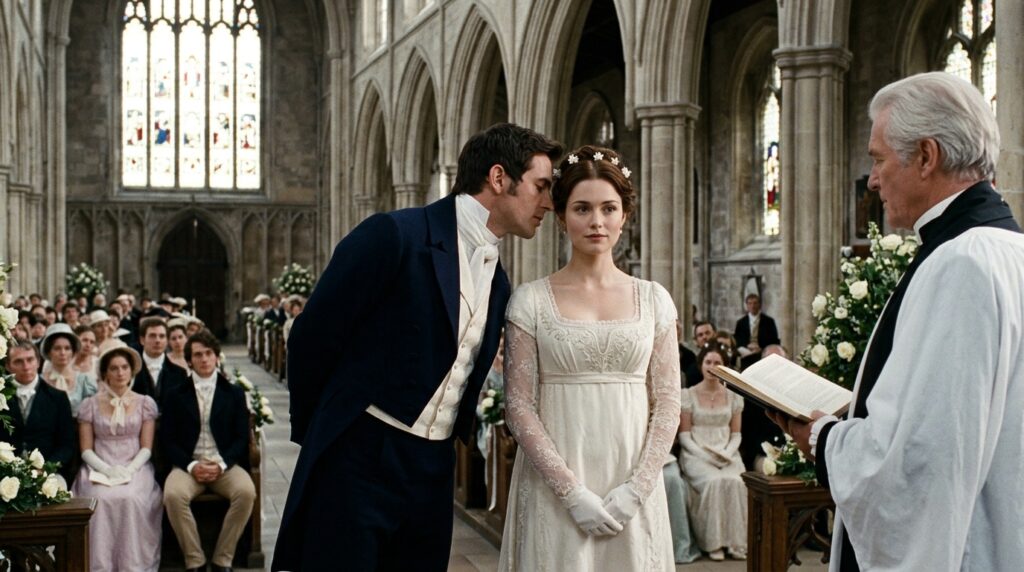
The bishop had been speaking for 9 minutes when the Duke of Northmere leaned toward his bride. He said in a voice pitched for her ear alone,
“I expect obedience in all things. You will find it simpler.”
300 guests filled the pews of St. Bartholomew’s. The June light fell through the east windows in broad pale columns, catching the dust motes that drifted above the congregation like a second silent audience. The altar flowers, white roses and myrtle as was proper, had been arranged since dawn by the Northmere gardener. He had been told twice that morning that they must be perfect.
Everything must be perfect. The Duke of Northmere had said so. And when the Duke of Northmere said a thing, the world around him rearranged itself accordingly.
Emmeline Bryce heard him clearly. She did not turn her head. She was aware of the bishop’s voice continuing above them, saying something about the duties of Christian marriage and the sacred bond.
She was also aware of the weight of the ivory muslin gown she wore. It had been made in 9 days by a seamstress in Bath who had wept with gratitude for the commission. She was aware of her father in the third pew, his hands folded over his prayer book, his expression carefully composed into something he hoped resembled happiness.
Reverend Matthias Bryce had agreed to this marriage because the living at Fullwood was ending. The bishop’s funds would not stretch to cover a clergyman with three daughters and no connections worth mentioning. He had agreed because Emmeline herself had told him she understood what was being offered and what was being asked and that she could bear it.
She had meant it. She had walked into this church with clear eyes and steady hands and the full understanding that she was exchanging her freedom for her family’s survival. She had considered that a fair transaction because Emmeline Bryce had never had the luxury of considering any transaction unfair simply because it cost her something, but she had not agreed to disappear.
3 seconds passed. She counted them by the rhythm of her own breathing. Then she turned, not to the Duke, but to the Bishop. She said with a composure so absolute that three women in the front pews would later describe it as terrifying,
“I do not.”
Bishop Ogilvie stopped speaking. His mouth remained open for a full second afterward, a detail that would be reported in at least four drawing-rooms before nightfall. He was 63 years old. He had performed over 2,000 marriage ceremonies in his 41 years of ministry.
In not one of them had a bride turned to him mid-ceremony and contradicted a statement that had not technically been addressed to her. He looked at Emmeline. He looked at the Duke. He looked back at Emmeline as though hoping she might clarify that she had been speaking to someone else.
“I beg your pardon?” Bishop Ogilvie said.
“I do not,” Emmeline repeated in precisely the same tone. “I do not expect to offer obedience in all things or find it simpler.”
The silence that followed was unlike any silence Emmeline had experienced. It was not the silence of an empty room or a country lane at dusk. It was the silence of 300 people holding their breath at once. It had a weight to it, a physical density that pressed against her chest and her temples and the thin skin of her wrists where her pulse beat with remarkable steadiness.
The Duke of Northmere did not move. He stood precisely where he had stood for the previous 9 minutes. He was tall and immaculate in a dark blue tailcoat with an ivory silk waistcoat. His jaw was set in the expression of a man who has never been publicly contradicted and cannot quite locate the mechanism by which one responds to it. His hands, which had been clasped loosely behind his back, shifted.











