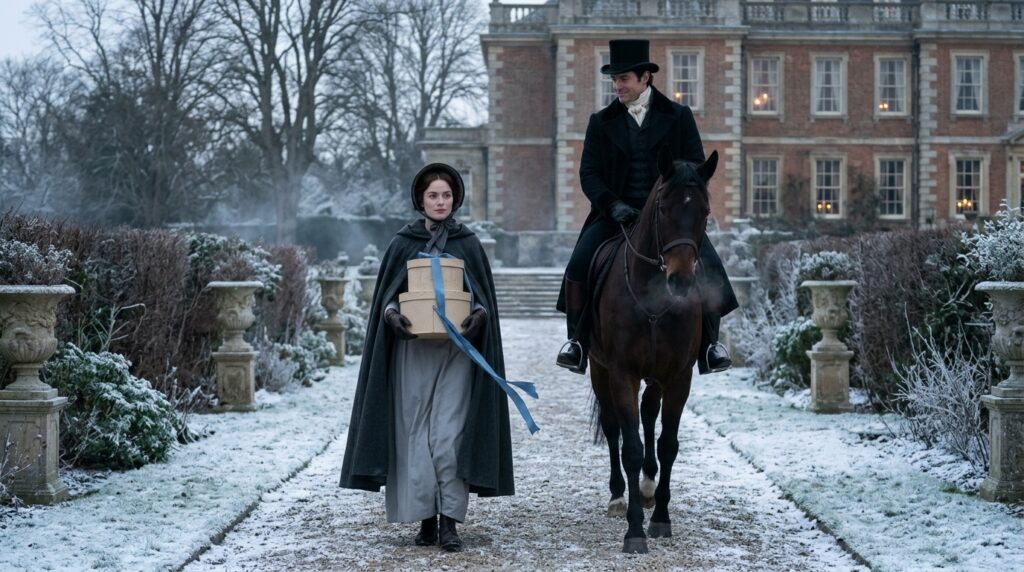
She Walked Through the Winter Garden — The Duke Rode Beside Her
Verity Bellamy had spent the afternoon preparing her younger sister for the Witchmere Ball when a maid brought word that three hatboxes had finally arrived with their delayed luggage. Lydia, already dressed in pale rose silk beneath a fur-trimmed winter pelisse, was too occupied arranging an appearance in the illuminated garden to collect them. Verity fastened her plain charcoal cloak over her dove-gray wool dress, tied on a dark felt bonnet, and went down to the stable courtyard herself. She was returning along the cleared garden path with the bandboxes stacked against her chest and two spools of blue ribbon tucked beneath the top lid when she saw a black horse waiting beside the yew hedge. Hugh Mercer, the Duke of Witchmere, sat in the saddle in a dark riding coat, heavy greatcoat, leather gloves, and a black top hat lightly dusted with snow.
“I hoped you had not gone back inside yet, Miss Bellamy,” Hugh said, keeping the horse well to the broad outer edge of the path. “You told me this afternoon that my South Garden walk was designed to make guests lose their way, and I have been waiting here to ask where you think it ought to lead instead.”
Verity stopped with the highest bandbox balanced just beneath her chin. A loose end of blue satin slipped from the lid and brushed her wool-lined glove. Snow lay on the clipped hedges behind the Duke, and the horse’s breath drifted between them in pale clouds. She had expected the garden to be empty now that the early December dusk was gathering.
Three hours earlier, the Bellamy carriage had drawn up before Witchmere Hall with frost along its windows and a broken strap where the missing hatboxes should have been secured. The courtyard was crowded with trunks, servants, and Mrs. Ruth Bellamy’s anxious instructions about Lydia’s evening gown. Hugh had come out to greet the guests before his afternoon ride, and while Lydia thanked him with her prettiest curtsy, he had asked Verity what she thought of the approach through the park. Tired from the cold post-chaise and assuming he was only being polite, Verity had remarked that the south path curled so persistently upon itself that anyone seeking the pond would be delivered back to the front door by supper. Her aunt had interrupted to ask after the luggage, and Verity had not imagined that the Duke would remember her observation, much less wait on horseback in his winter garden to hear the rest.
“I did not expect Your Grace to take a travel-weary observation as a formal critique of the estate,” Verity said, steadying the lowest box against her cloak. “If I had known I would be called to account for it before the first quadrille, I would have praised the symmetry of the gravel instead.”
“Everyone praises the gravel,” Hugh replied, his mouth curving beneath the brim of his hat. “Four gentlemen have already assured me that the drive is the finest in the county, though three arrived after dark and could not possibly have seen it. May I call someone to take those boxes before they obscure you entirely?”
“They are quite light, Your Grace. Only the things my sister feared she would have to manage without for one evening.”
Verity glanced down at the dove-gray wool visible below her cloak. It was clean, neatly fitted, and warm enough for the journey, with no delicate flounces to catch on carriage steps or hamper her while she knelt beside trunks. Her winter boots were serviceable rather than fashionable, and the wool shawl beneath her cloak had been mended at one corner. She had intended to carry the boxes upstairs, make sure Lydia had everything she required, and ask for a tray of tea before settling beside her bedroom fire with a book.
“I am only taking them back to the house. You must have fifty guests waiting for you by now.”
“Fifty-two, when your aunt and sister joined the company in the conservatory a moment ago,” Hugh said.
He did not turn his horse toward the stables. Instead, he remained beside the hedge, the reins resting quietly in his left hand. The path was wide enough for her to pass freely, and he waited as though he had nowhere more important to be.











