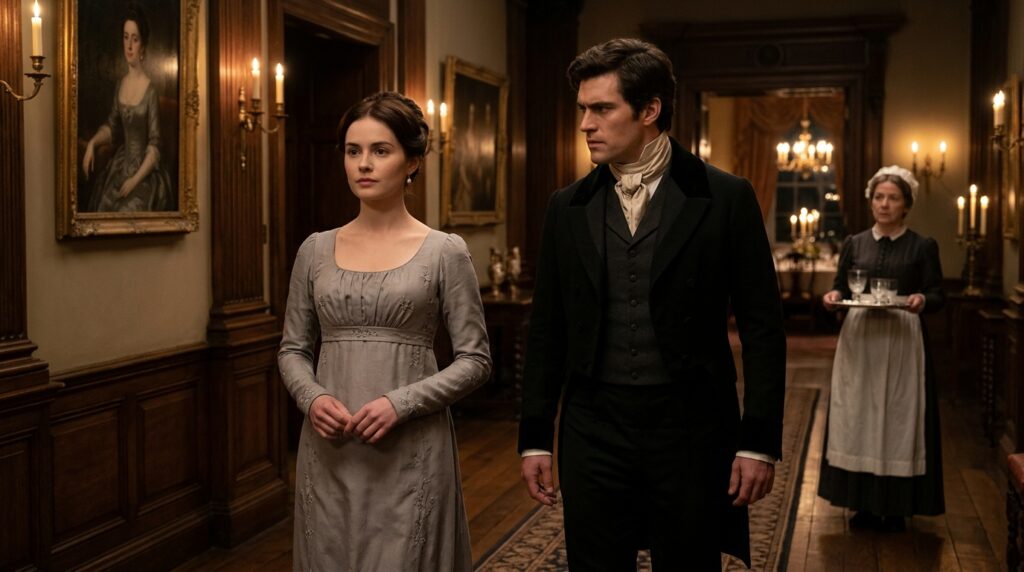
The West Wing, meanwhile, grew quieter. Nathaniel noticed this the way one notices a draft, not the thing itself, but its effects. His breakfast was still served in the dining room. His study was still maintained. His clothes were still pressed and his fire still laid.
But the house felt emptied of something he could not name. A subtle withdrawal of warmth that had nothing to do with temperature. The footmen were present when summoned, but no longer anticipated his needs. The flowers in the hall were replaced less frequently. The cook sent dishes that were correct, but uninspired, as though the kitchen’s attention had been gently redirected elsewhere.
He told himself this was what he had wanted. He had married a woman he did not choose, and he had put her where she could not trouble him, and his household was running as it should. He sat in his study with the estate accounts and the correspondence from his solicitors and the invitations to dinners he did not wish to attend. And he told himself that the silence was peace.
It was his mother who said it first. The Dowager Duchess had taken Nathaniel’s side in the matter of the East Wing. Not vocally, not with any explicit endorsement, but with the quiet complicity of a woman who had herself endured an unhappy marriage and believed that endurance was what wives were for.
She had watched Phoebe’s removal with the same expression she wore when furniture was rearranged. Mild interest, no objection. But the Dowager was also a woman who understood houses, and she understood that a house with two centers of gravity was a house in the process of choosing.
She crossed to the East Wing on a Thursday afternoon in late June, 3 months after Phoebe’s banishment. She had not announced her visit. She simply appeared in the doorway of the sitting room where Phoebe was reviewing the Michaelmas accounts with Cavender, and stood there until they looked up.
“I came to see what you have done with the wallpaper,” she said.
Phoebe had, in fact, done nothing with the wallpaper. The French hand-painted paper in her bedchamber remained as it was, peeling, water-stained, beautiful in its ruin. She had chosen to leave it. It was the one extravagance she permitted herself, the acknowledgement that some things are lovelier for having been neglected than they would be if restored.
The dowager walked through the rooms. She said very little. She ran one gloved finger along the mantelpiece in the first bedchamber and inspected it for dust. There was none. Mrs. Tull’s girl had been thorough.
And she touched the curtains Phoebe had rehung, pausing at the fabric as though she recognized it from another era of the house. She examined the books that had begun to accumulate on the library shelves, volumes borrowed from the main library and not returned, parish registers Cavender had brought for reference, a botanical guide Phoebe had ordered from London, and a slim volume on estate drainage that she had found in the late Duke’s collection and marked at three separate pages. The dowager opened this last book, noted the markings, and closed it without comment. She stood for a long time at the window of the south-facing sitting room, looking out at the gardens below, where two of the under-gardeners were repairing the border wall that had collapsed in the spring rains. The afternoon light was warm on the floorboards, and somewhere below the window, a blackbird was singing, the full, unhurried song of a bird that has found a territory it intends to keep.











