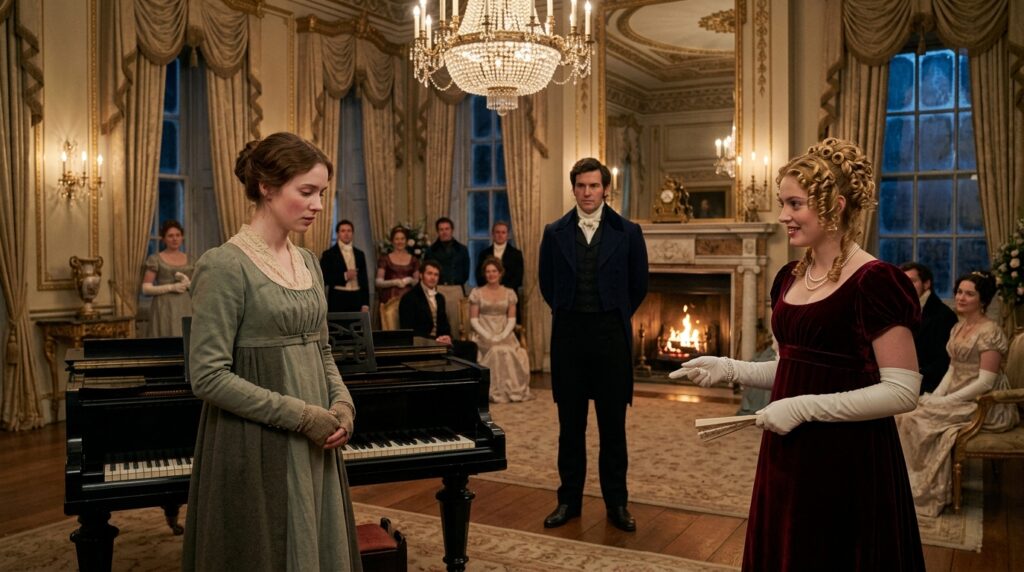
“Let the poor cousin play first,” said the young woman in the rose-colored silk, and her voice carried across the Duke’s music room like a bell. “Miss Ridley is said to be so very fond of the instrument. It would be a kindness to let her begin.”
A ripple of laughter ran along the gilded chairs. It was not loud laughter. It was the soft, well-bred kind hidden behind fans and gloves, which is crueler than any shout.
Imogen Ridley sat on the last chair of the last row, in a gray gown that had been turned twice and let out once. She had been placed there on purpose, near the door, where a poor relation belongs. Now 40 heads turned to look at her.
“Come, Miss Ridley,” said the Duke’s sister, who had been told it was all arranged and saw no harm in it. “The Prince Regent is expected within the hour, and we must not keep the music waiting.”
Imogen rose. Her hands were cold, and her knees did not feel entirely her own. The walk from the last row to the pianoforte was perhaps 20 paces, and she would remember every one of them for the rest of her life. She passed her cousin, Lady Dorothea, who smiled sweetly and whispered:
“Do try not to weep on the keys.”
She passed her aunt, the Countess of Oxley, who looked straight ahead as though she had never seen the girl before. She passed a tall, dark-haired gentleman in a navy coat embroidered with gold, who stood by the mantel and did not laugh at all.
Before the candles burned down that night, the poor cousin in the turned gray gown would silence 40 of the finest people in London. The Prince Regent himself would beg her to play again, and she would come face to face with the man who had stood in the rain beneath her window. And the cousin who had laughed would wish for the rest of her life that she had kept quiet.
The instrument was a Broadwood grand, the finest in London, its lid raised like a wing. Imogen sat down. She drew off her darned gloves, laid them in her lap, and set her bare fingers on the keys. Behind her someone sniggered, and someone else said:
“Oh, hush. Let us hear her stumble.”
She closed her eyes. And for a moment, she was not in a duke’s house at all, but in a small, cold room above a church, with her father’s hand resting on her shoulder.
Her father had been the organist of a parish church in the city of London, a man of such gifts that visiting masters from Vienna had climbed the narrow stairs to hear him. He had also been the poorest man Imogen ever knew. He gave his music away as other men give away bread, and he died in the winter of 1813 owing money to the candlemaker. Her mother had been the younger sister of the Countess of Oxley. She had married the organist for love against every wish of her family, and had been cut off for it.
She died when Imogen was 16, and the two sisters never spoke again. So, when the organist was buried, there was nothing left but a trunk of music in his own hand, a few books, and a daughter of 20 with no fortune at all. The Countess, who liked to be thought charitable, sent her carriage for the girl. It was understood from the first moment that this was a kindness, and that kindnesses must be repaid. Imogen repaid it for 3 years.











