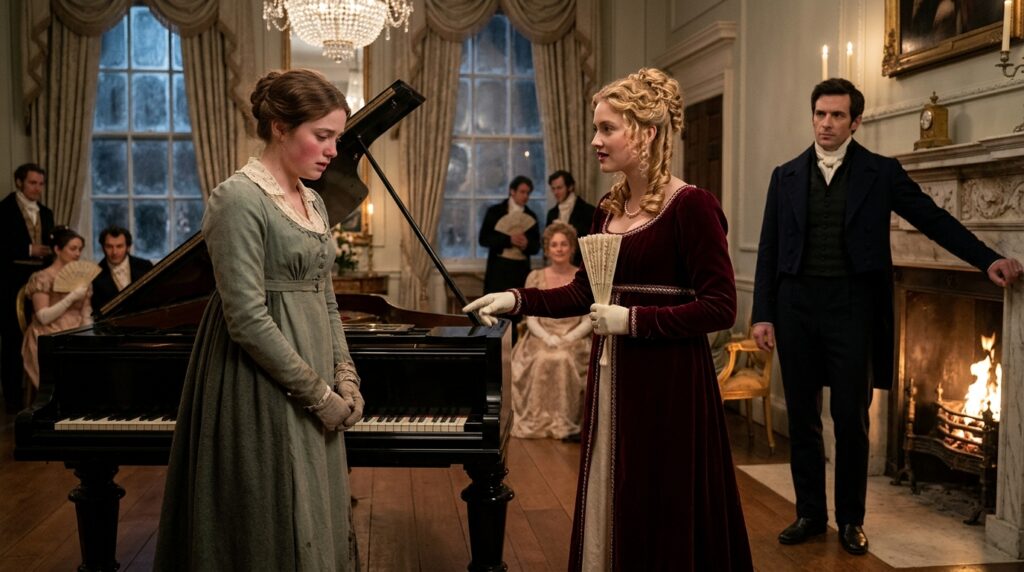
Now she sat at the Broadwood with her eyes closed and her father’s hand rested on her shoulder.
“Do not play for them,” he had told her once when she was 12 and frightened before a church full of strangers. “Play for the music. The music does not know who is listening.”
Imogen opened her eyes and began. She played Handel. It was the air and variations from his suite in E major, which everyone in that room had heard a hundred times from a hundred young ladies, and which not one of them had ever truly heard at all. She did not play it loudly. She played it as her father had taught her, with the left hand steady as a heartbeat, and the right hand singing above it, each variation growing out of the last like leaves out of a branch.
The first variation was simple and clear. The second quickened. By the third, the fans had stopped moving. By the fourth, there was no sound in the room but the instrument.
The Duke’s sister had sat down without knowing it. Dorothea’s friends had stopped whispering and were staring at the gray back at the pianoforte as though it had turned to gold before their eyes. And the Duke of Wincliffe standing by the mantel had gone perfectly still. He knew that touch.
He had stood in the rain for it. The last variation rose, bright and swift and joyful, and ended with a chord that rang through the room and died away into a silence so complete that Imogen could hear the candles burning. She lifted her hands from the keys and did not dare to turn round. Then, from the door, a voice said:
“Good God, who is that?”
The Prince Regent had come in, as was his habit, late and without ceremony, during the music. He stood in the doorway in his dark blue coat with the star of the Garter on his breast. He was a very large man now, 53 years old and florid, with the small bright eyes of a man who misses nothing, and the easy charm that had once made half London forgive him anything. He had played the violoncello in his youth.
He had sat, as a young prince, in the same room as Haydn. He came forward through the company, which rose and sank again like a field of corn, and stopped beside the pianoforte. Imogen stood up and curtsied so low she nearly lost her balance.
“Miss Ridley, Your Royal Highness,” said the duke, who had crossed the room without anyone seeing him move, “a guest of the Countess of Oxley.”
“Miss Ridley,” said the prince, “I have heard that piece since I was a boy. My father the king would have no other composer in his house. I have never heard it played like that.”











