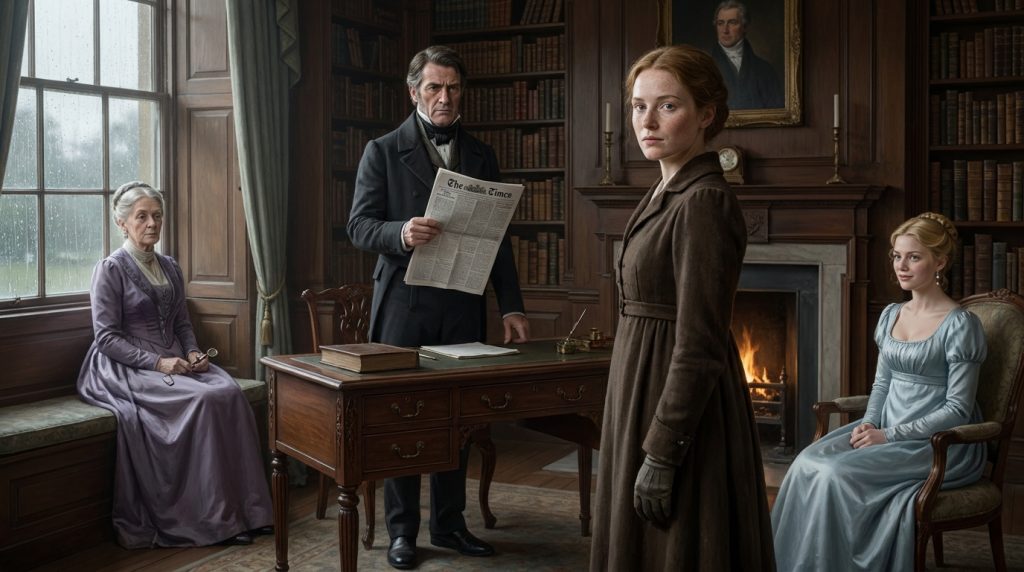
“Wanted: A Mother Who Can Climb Trees” Ran in The Times—The Duke Had No Idea His Daughter Wrote It
There is a particular cruelty in being wanted in print. It is not the being wanted. It is learning in front of strangers that the want was never meant for you.
“I did not write this,” said the Duke of Raiseford, and laid The Times on the desk between them like a bill he refused to pay.
Nobody in the library moved. Rowena Penrose, eight-and-twenty, unmarried and holding a return ticket to Basingstoke she had paid for herself, stood before the desk with rain still dripping from her hem. She had expected to be laughed at. She had expected a housekeeper’s interview in a cold back parlor. She had not expected the duke himself to read the advertisement aloud in a voice like a magistrate’s to every woman who had answered it.
There were four of them on the long bench beneath the windows. Three in good silk. One in brown wool, turned twice at the cuffs. Too tall for the bench and too freckled for the silk. The silk had been watching the wool since the station, the way a shop watches a customer who cannot afford it.
In the window seat sat the Dowager Duchess of Raiseford in lavender half-mourning, with a lorgnette folded in her lap like a closed knife. Fenwick, the butler, stood by the door. He had the face of a man asked to witness a hanging who had decided to count the spectators instead. Every one of them expected the woman in brown wool to leave in tears.
“Wanted,” the duke read without inflection. “A mother who can climb trees. She must know her sums and must not mind mud. She must not be frightened of Papa. Apply in person at Raiseford, in the county of Hampshire, on any Tuesday.”
He folded the paper once, sharply, along the column. Rowena noticed the fold. She had read the advertisement several times on the train. There was one more line beneath the place where he had stopped. He had stopped one line short.
“It has run for three weeks,” he said. “Ten women have come to this house in answer to it. Nine of them asked the size of my income before they asked the age of my daughter.”
His eyes were brown, not the cold gray that every rumor in the county had promised her. A warm, dark, ordinary brown, like strong tea. His face was weathered by riding his own land, graying at the temples, 37 and looking every hour of it. He was not tall and did not need to be. He held 40,000 acres, a seat in the Lords, and a reputation for driving five governesses from his house in two years.
He was looking at Rowena as though she were an error in a column of figures.
“You are the tenth,” he said. “You have asked me nothing.”
“You have not yet given me the opportunity, Your Grace.”











