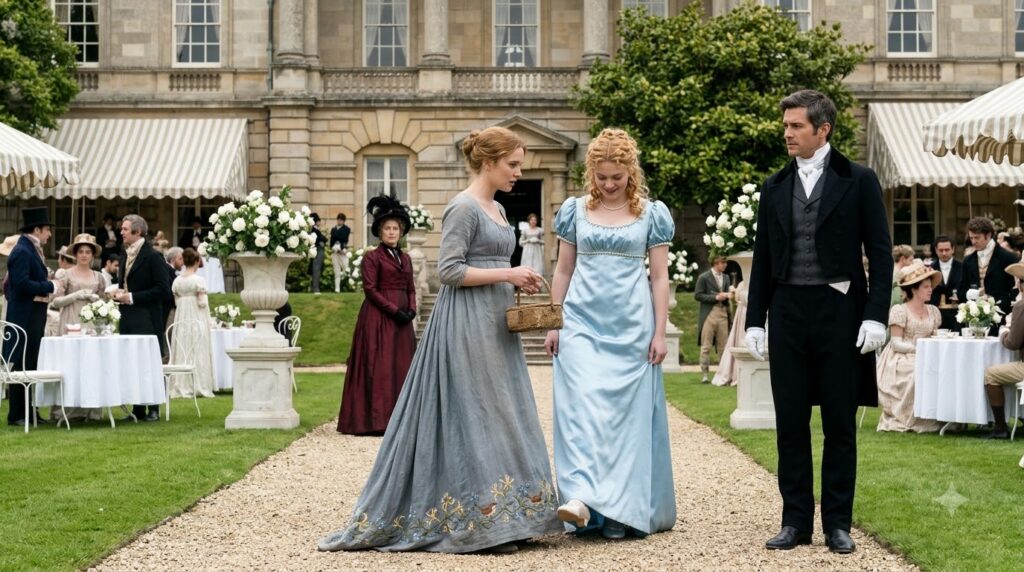
In London, in the spring of 1819, there was a young woman who sewed the dresses that others would wear to shine. She spent her nights hunched over silks that would never be hers by the light of a single candle, while downstairs her stepmother counted coins that weren’t hers either. No one in that Mayfair house called her by her name with affection. To her family, Eleanor Ashcombe was the seamstress. To society, she was the spinster without a dowry, the plain girl with no prospects.
But Eleanor kept a secret she didn’t even understand herself: the last embroidery her mother left before she died. A small blue-eyed wren among honeysuckles and forget-me-nots. And, on a ball night, when that embroidery was torn before an entire hall that laughed, the most coveted man in England knelt to pick up the piece of fabric and froze, because he had seen that bird before, for 26 years, carrying that same design close to his chest, without knowing who had made it. This is a story about what others despise and yet carries the most precious value. About an inheritance that doesn’t fit in a vault, about a woman who learned to ask permission to exist, and about the day she decided to never stay silent again.
London, spring, 1819. The social season boiled like a pot forgotten on the fire. The salons of Mayfair lit up every night with hundreds of beeswax candles. And the sweet perfume of that wax mingled with the scent of rose water, rice powder, and port wine. Outside, the fine drizzle, that English mist that never quite becomes rain, but never goes away, covered the cobblestone streets with a damp sheen.
Carriages passed through, muddied up to their axles. Horses let out steam from their nostrils and coachmen, huddled in their wool coats, waited for hours at the doors of mansions, while inside the destinies of many lives were decided, because that is what the season meant. It wasn’t just dancing and conversation; it was a market. Anxious mothers paraded their daughters like jewels in a display case, calculating dowries, titles, lands, and annual incomes with the precision of bankers. A young lady had few seasons to find a husband.
After that, she would only be remembered as the one who was left behind. It was in this world of imported silks and calculated alliances that twenty-six-year-old Eleanor Ashcombe survived like a shadow within her own home. She had light brown hair, almost honey-colored, always worn in a simple bun, without ribbons, tortoise combs, or any ornament that might draw attention. Her eyes were a bluish-gray, difficult to describe, like the London sky just before dawn, observing everything with a calm that many mistook for indifference; but it wasn’t indifference, it was weariness.
The weariness of one who learned too early that showing feelings only gave others one more weapon. Eleanor’s fingers were thin and long, bearing small calluses on the tips, marks of years of needle and thread. She wore faded muslins, altered so many times that the fabric had lost its original luster and color. A dress that was once sea-green was now a sad, grayish green.











