Then he asked Elvara privately if she would want to serve on it. He didn’t ask if she might, or say that he would allow it. He asked if she wanted to. She said yes. The repaired system also changed how Morvane recorded its own history.
At Elvara’s suggestion, Edric ordered practical instructions copied beside every surviving ancient label. They added notes explaining which terms came from mill workers, which from formal Austeric, and which remained uncertain. Callus contributed linguistic cautions. Jorvin added historical dates only where evidence supported them.
Farmers described seasonal changes the old plans never mentioned. Tavern attended the first commission meeting and nearly interrupted three times, but each time he caught himself. That restraint did not erase seven years of assumption. Elvara did not pretend it did.
Their marriage improved slowly through ordinary questions that should have been asked long before. He asked what her father had taught her about winter drainage. He asked why she inspected the kitchen wells after a long rain. He asked why she had once ordered gravel moved from the south courtyard before anyone noticed standing water there.
Some answers were technical. Others were simple habits learned from watching people who worked outdoors. For Elvara, the change mattered less because Tavern finally admired her knowledge and more because he stopped treating knowledge as valuable only after another man certified it. For Tavern, that lesson proved uncomfortable.
He had always thought arrogance meant refusing correction after being proven wrong. Now he understood another kind. Sometimes arrogance began much earlier in deciding who was worth asking before the question had even been spoken. And that realization stayed with him long after the storm clouds finally disappeared beyond Morvane’s hills.
Months later, Professor Jorvin returned for another dinner. Again, maps appeared between plates. Again, some ancient question became an argument. A younger scholar finally turned toward Elvara and asked Her Grace:
“What do you think?”
Before she could answer, Tavern told him to be careful. Everyone looked at him. For one heartbeat, the old arrogance seemed to return. Then he added:
“If she tells you you are reading the wrong word, I suggest you check it twice.”
The table laughed. This time, Elvara laughed, too. Tavern’s greatest mistake was not being wrong about the inscription. It was spending 7 years believing he already knew the limits of the woman he married.
By autumn, the Greywood Channel had been fully inspected. The Eastern Spillway was restored. Its stonework was strengthened, its gates were repaired, and its operation was added to Morvane’s modern flood plans. Beside it stood a new marker.
Elvara’s name was not carved upon it. She had never asked for a monument. Instead, the stone carried the corrected instruction in clear modern Austeric. It read, “When the northern water rises, release the eastern mouth before the third mark.”
One afternoon, Elvara and Tavern walked beside the channel while clean water moved through the restored course. Tavern stopped at the marker. He asked if she knew what bothered him most. She asked:
“What?”
He said:
“I thought I was giving you an impossible question.”
Elvara looked at him and said:
“You were.”
He frowned. She continued walking and said:
“I simply knew where to begin.”
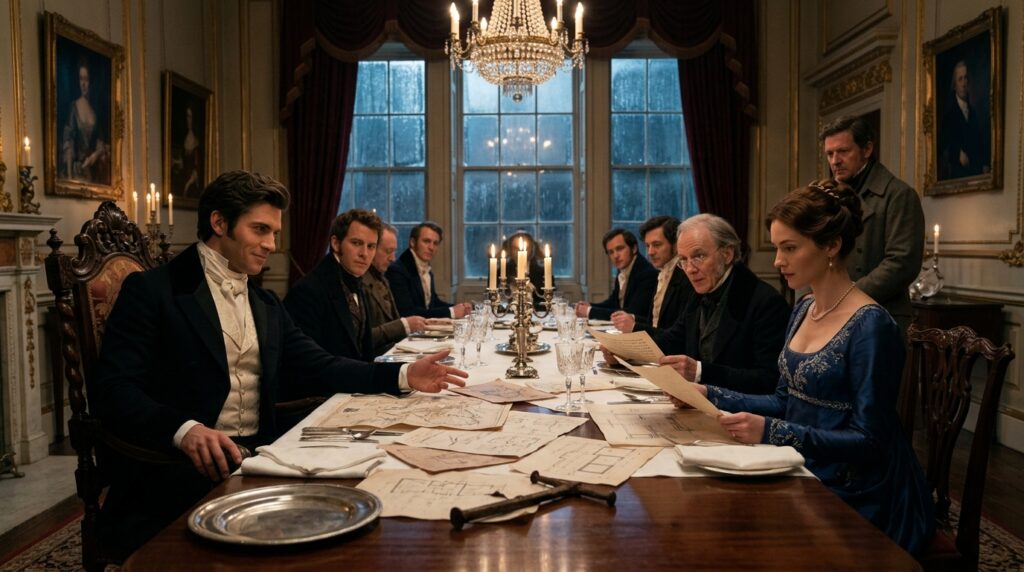
Tavern followed. Duke Tavern Montclair had filled his table with men whose knowledge he respected. There were historians, linguists, and surveyors. They were men whose opinions he would never have dreamed of mocking.
Then his wife questioned them. Tavern made the mistake of believing that, because he had never asked what she knew, there could be nothing worth knowing. So he smiled across the table and gave her the challenge he was certain would embarrass her. He told her:
“Since you know so much, explain it.”
Elvara did. She explained the word. She explained the channel. She explained the broken pin lying between their dinner plates.
And when she finished, the scholars Tavern had expected to laugh at her were no longer laughing. They were reading the inscription again. Because the Duchess had not merely answered her husband’s question. She had revealed that everyone at his table, including the Duke himself, had been asking the wrong question.











