The maid was a broad, cheerful girl from one of the moor farms. She arrived blowing on her fingers and talked all through the kettle and the porridge about the bonfires they had lit in the fields to burn off the bracken. Rosabel let the talk wash over her and toasted the bread and carried the trays up two flights. Jess still half asleep, squeezed her hand when she set the chocolate down and whispered:
“Was it very dreadful for you last night? It was dreadful for me.”
Aunt Teresa, sitting up against her pillows in a lace cap, did not look up from her letters.
“You will take the brown bread back,” she said. “I asked for white, and you will be home by 4:00. We are calling on the Kellos.”
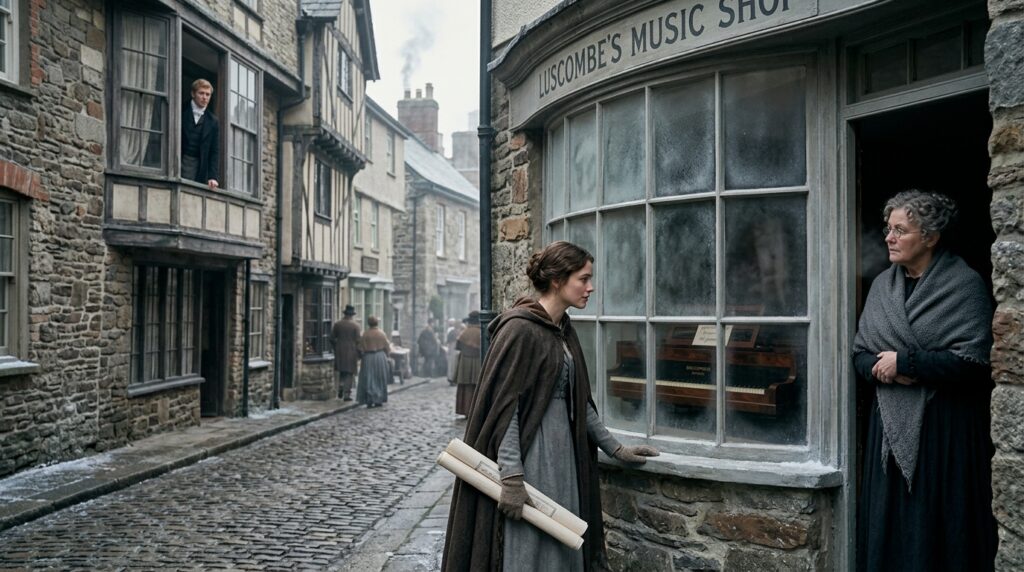
At 7, Rosabel put on her bonnet and her old cloak and took down the long roll of paper from the top of the kitchen dresser, where she kept it out of the reach of the steam. It was tied with tape and wrapped in oil cloth against the weather. Inside were three sheets of drawings she had finished by candle light in the attic the night before, her breath smoking over the paper while the house slept. A laborer’s cottage of four rooms with a chimney that would draw and a floor that would not flood. The same cottage in section cut through from roof to footings as if with a knife and a drain running from the back of the cottage down the slope to a ditch with every fall of the ground marked in her small square hand.
She tucked the roll under her arm and went out into the frozen town. Tavistock at that hour was blue and white and silent. Smoke stood straight up from the chimneys. The granite of the church tower had a bloom on it like the skin of a plum. A Carter was leading two moor ponies up from the river, their breath rising in clouds, their shaggy coats furred with hoarfrost.
Rosabel went the long way, as she always did, down past the abbey gate, across the corner of the square, below the windows of the inn, and into the short, steep street, where the ironmonger was just taking down his shutters, and three doors along from him, the bow window of Luscombe’s music shop threw back the early light. She did not decide to stop. She never decided it. Her feet simply stopped, the way a horse stops at its own gate. The piano stood where it always stood, just inside the glass, angled so that the light fell across the lid.
Rosewood, dark as strong tea, with the fine brass line along the edge and the little brass handles at the sides. The lid was closed over the keys. Beside it, on a card propped against a music stand, somebody had written in a clear hand, “A square pianoforte by Broadwood of London. Fine tone. 40 guineas.”
40 guineas. She earned four shillings for a set of drawings when she was paid at all. She had worked it out once on the back of a spoiled sheet, and then she had torn the sheet up because the answer frightened her.
If she saved every penny and ate nothing, and never bought another candle, she could have that piano in something over 5 years. By then it would be gone. It would be gone long before then. Every morning she came round the corner, braced for an empty window.
Every morning it was still there, and she let out a breath she had not known she was holding. She put her gloved hand on the cold stone of the sill. Then, because the street was empty and nobody was watching, she let her fingers move. Not much, a small movement, like someone tapping out the time of a song.











