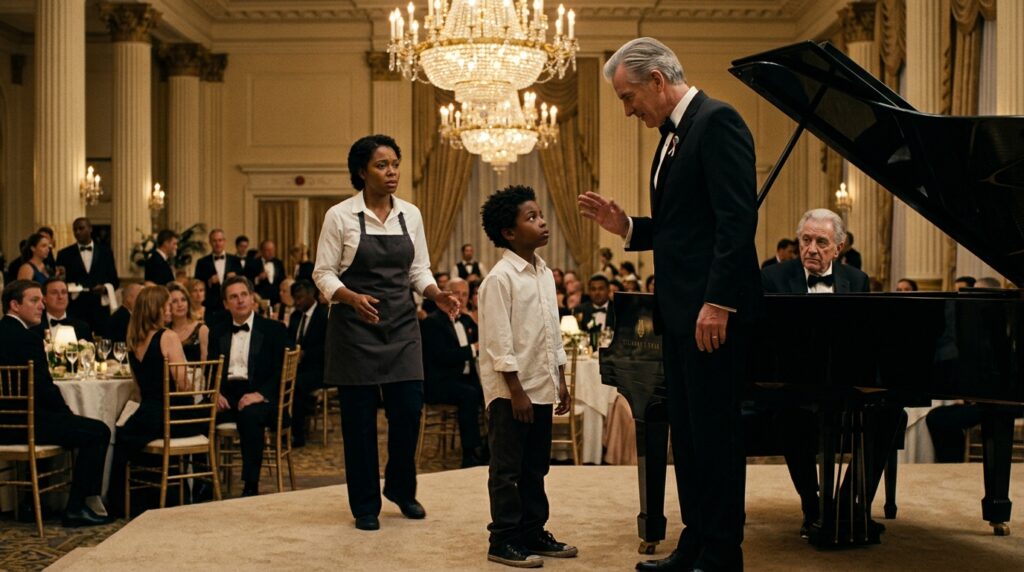
The crystal chandeliers of the Meridian Grand Hotel threw soft gold across the ballroom floor that Saturday evening, and for a moment Noah Hale stood in their light as if he had wandered into someone else’s dream. He was ten years old, his brown hair a restless tangle that no amount of his mother’s hurried combing in the staff hallway could tame. The inexpensive white button-down she had pressed that afternoon hung a little loose at the shoulders. His dark trousers were too long and puddled faintly at the ankles above a pair of worn black sneakers that had once been his cousin’s. Around him, the charity dinner glittered: black ties, champagne, the low murmur of money speaking softly to itself.
He had slipped away from the catering corridor while Elena Hale carried trays of glazed salmon and lemon tarts between the swinging doors. He had not meant to cause a scene. He had only meant to look, really look, at the Steinway that sat near the raised platform like a dark, waiting animal. Its lid was propped open. Its keys shone under the lights. Noah’s fingers, still faintly scented with dish soap from helping his mother earlier, twitched at his sides.
The ballroom smelled of waxed wood and cut flowers and the faint metallic sweetness of chilled wine. Waiters moved like carefully trained shadows between the round tables. A string of white lights traced the molding near the ceiling. Somewhere a woman laughed too loudly and then covered her mouth, as if the room itself had asked her to be elegant.
Noah knew he did not belong in the picture the evening was trying to paint. He knew it the way a person knows cold water: immediately, in the skin. Still he walked toward the piano, drawn by a pull older than manners.
He was almost close enough to touch the bench when a voice cut across the polished air.
“Easy, kid. That isn’t a toy.”
Noah turned. The man who had spoken was perhaps in his sixties, dressed in a black tuxedo that fit him the way expensive things fit people who never had to wonder about the price. His hair was silver at the temples. A charity ribbon sat neat as a medal on his lapel. Around them, a few guests glanced over, amused or irritated, the way people glance when a child has wandered into the wrong room.
“I know,” Noah said.
“Then save yourself the embarrassment.”
Elena appeared then, breathless from the service corridor, her catering uniform slightly askew, a damp curl stuck to her forehead. She took Noah’s shoulder with the careful urgency of someone who knew exactly how quickly a night like this could turn against people like them. She had worked enough galas to understand the invisible fences. Children of staff were meant to be invisible, or at least quiet, or at least elsewhere.
“Come on, honey. We should go.”
Noah looked at the piano. He looked at his mother’s tired eyes. He looked at the man in the tuxedo, whose smile was thin and certain.
“I just wanted one chance,” Noah said.
From the far side of the instrument, the hotel pianist rose. He was older than the guest, older than almost anyone in the room, with hands that had learned patience the hard way and a face mapped by decades of late nights and soft applause. His name was Harold Quince. He had played this ballroom for twenty-three years. He had seen every kind of evening: weddings that dissolved into arguments, anniversaries held together by cake and denial, fundraisers where generosity and vanity shared the same champagne flute, and something in the boy’s posture made him set down his glass of water and step forward. The stillness of someone who was not asking for charity so much as air.











