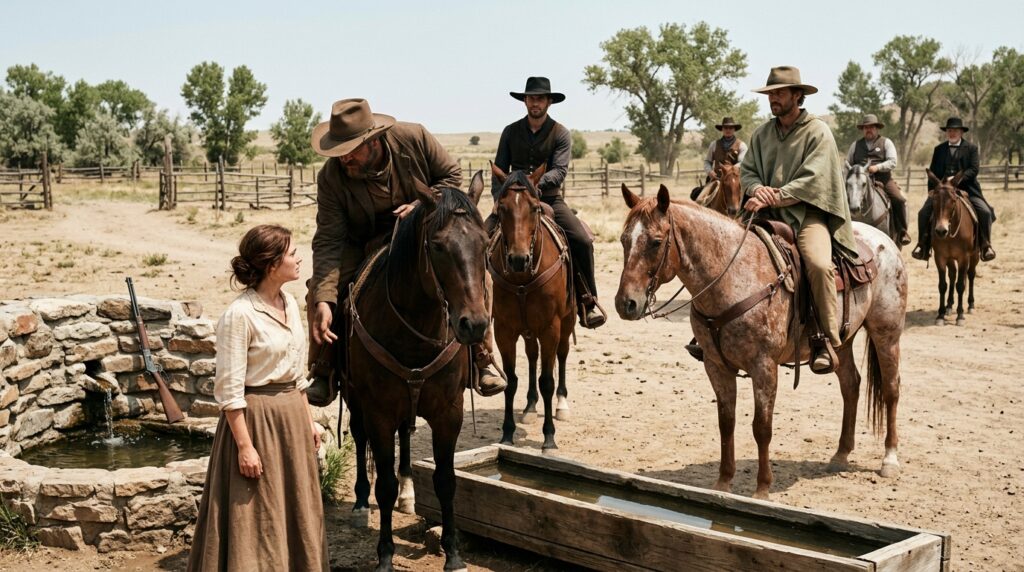
Rand’s right hand started its move toward his belt. What happened next? Friend, nobody who witnessed it could properly reconstruct it afterward, and I was right there. One moment the man in the poncho was sitting still with both hands resting quiet on the saddle horn. The next, a single shot cracked open the August air and Willis Rand’s gun hand erupted in a spray of blood, and he was bent double over his saddle screaming, the revolver he’d barely cleared spinning away into the dust. Doyle released Clara’s wrist like he’d grabbed hold of something burning.
The two flanking riders went so motionless they might have been statues. Nobody reached for anything. Nobody produced a single sound except Rand, who was cursing in broken gasps, pressing his right hand against his chest. The man in the poncho had not shifted from his seat. A thin thread of smoke curled from the old Colt in his hand, and then he returned it to his holster in one clean motion, the way you’d slide a letter back into an envelope.
“He’s still alive,” he said, to no one in particular. “That was deliberate.”
He looked at the sheriff. Huck had turned the color of old ash.
“You want to do your job today?” the man said quietly, “or keep doing his?”
He tilted his head in the direction Pruitt’s riders had come from. Huck said nothing. The man looked at the preacher. Kemp had his eyes fixed on his mule’s reins, hands clenched white.
“Preacher,” the man said, “you’re going to have considerable trouble sleeping after this.”
Then he turned to the four remaining riders and delivered his final observation the way a man states an observable fact about weather.
“Now, get off this land.”
They got off the land. Rand, hunched and hissing, let one of the riders lead his horse by the reins. They went south toward Cutter Creek, and the sound of their horses faded out, and the cottonwoods along the spring stopped trembling, and Clara Whitmore stood beside the stone basin with her father’s Winchester now in her hands, watching the last of them disappear over the rise. She looked at the man in the poncho.
“That was Willis Rand,” she said, “from Abilene.”
“I know who he is.”
“You shot his gun hand.”
“I did.”
She studied him for a moment.
“You want to tell me who you are?”
He was quiet. Then, “My name is Cal Devereaux. I needed water for my horse.”
He swung down from the saddle and led the roan back to the trough and let her finish drinking. The name Cal Devereaux meant nothing to Clara Whitmore. It meant quite a lot to certain men across four territories in the state of Texas. 10 years before, at 21, Devereaux had taken a deputy’s position in Laredo under a federal marshal named Clarence Poe. For 6 years he tracked fugitives across country that would kill a careless man without trying, brought in rustlers and killers and worse, and built a reputation the way dangerous reputations build, quietly, through the testimony of men who had seen what he was capable of and made sure they were somewhere else the next time his name came up.











