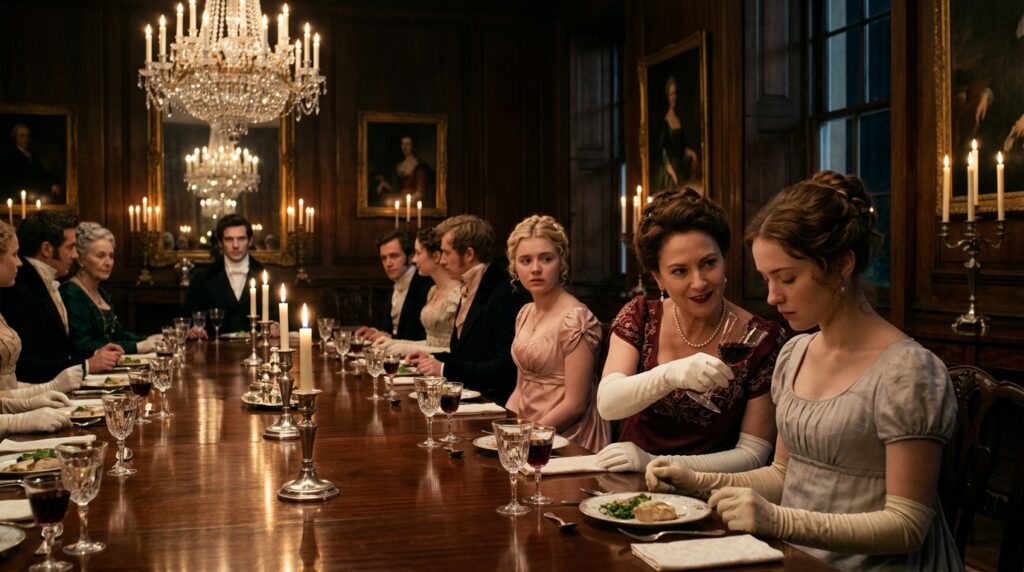
“Ah, and my niece is to be settled at Michaelmas,” her aunt said. “Mr. Turn of Leek. So we shall be short of hands by the winter, and I must part with something.”
Catherine Stanbridge was standing 9 feet away with her hand under a brown horse’s jaw. She did not move. The horse did a little because horses feel what people do not say, and she put two fingers flat on his cheek, and he stood again. Michaelmas was a fortnight off. It was the 15th of September, 1817, and it had rained on the moor since Thursday.
The yard at Hollenhay was wet from the pump to the gate. Beyond the gate, the ground went up and up in the gray, all rush and stone. And somewhere above the cloud there was a hill her father had taught her the name of. Her aunt stood under the arch, out of the weather in a dry shawl. There were two gentlemen with her.
One was a stud groom in a good plain coat, a Rockholm man, come over the tops to look at horses. The other was taller and said nothing at all, which in that yard was unusual enough to be noticed. Catherine kept her eyes on the colt’s ear. 10 years, she thought. 10 years, and she tells a stranger before she tells me.
She was 2 and 20. She had come to Hollenhay in the October of 1807 in a carrier’s cart with a box between them. She was 12 years old. Her brother was 2.
It was 12 days after the fever took her mother and 9 days after it took her father. Her father had been a veterinary surgeon. He had trained at the college in London when the college was 5 years old and the whole notion of it was a joke in the hunting field. Then he had come home to Warslow.
He spent 20 years proving the joke wrong in the wet for four shillings a visit and often for nothing. Her aunt was her mother’s elder sister. Mrs. Mirabel Critow of Hollenhay widow 51 years old with a daughter to bring out and a house that ate money and a stud of 16 horses. That was the only thing on the place that made any.
She had never once struck Catherine. It was important to be exact about that. In 10 years she had not raised a hand or her voice, and there was no mark anywhere on the girl that a magistrate could have looked at. She had simply over 10 years put her in the stable.
“Bring him round, Catherine,” her aunt called. “Let Mr. Miller see his action.”
Catherine brought him round. The brown was a good sort, standing 15.2 hands, and he went well enough on the flat, wet cobbles, and the Rockholm groom watched him with his head on one side.
“Rising five,” said Mrs. Critow.
The groom said:
“He’s a nice sort.”
“He is my late husband’s breeding. We have no papers, you understand? My husband kept nothing. But I can tell you exactly what he is. Rising five, never been sick a day.”











