She went up to bed with the candle and left her niece to bank the fire. Catherine sat a while in the dark parlor. Then she put her hand in her pocket, as she did most nights, and found the flat piece of brass she had carried there for 10 years. It was 2 and 1/4 inches long, with a screw hole at each end, and one letter deeper than the rest, where the engraver’s hand had slipped. Stanbridge.
It had come off her father’s saddle in the November of 1807 when her aunt had the saddle taken into the harness room and the plate unscrewed because she said a dead man’s name on a flap looked poor. The saddle was still there. So were the two empty screw holes. The card came the next morning at 9. It came by a Rockholm servant on a Rockholm horse and it was addressed on the outside in ink in a hand that was not a secretary’s.
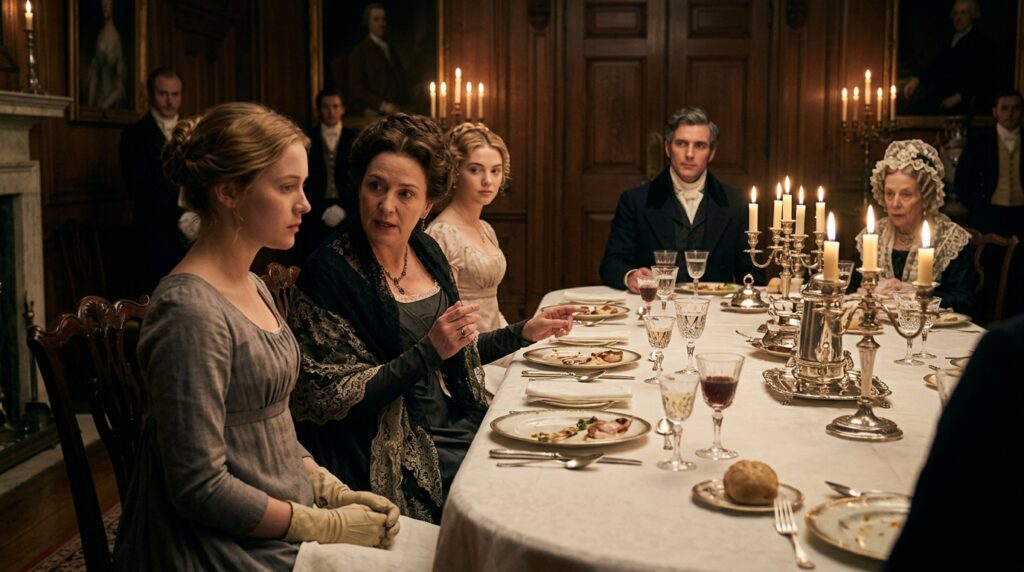
Miss Catherine Stanbridge. Her aunt turned it over twice before she gave it up. Inside the Duke of Rockholm presented his compliments and begged the honor of Miss Stanbridge’s company at dinner at Oldridge on Monday the 22nd at 6:00. Mrs. Critow and Miss Critow were included in the invitation.
An answer was requested in Miss Stanbridge’s own hand. Catherine read it standing in the passage between the kitchen and the stairs. She had held perhaps £400 of her aunt’s money in 10 years, and never a farthing of her own. She had never in that time had a letter.
Nothing at Hollenhay had her name on it except the stable column, and she had written that herself. She had to borrow the paper from her cousin Aurora, who gave it with a small laugh, and watched her cross the yard with it. She wrote the answer, standing at the corn bin, with the ink from the stable office, where the accounts of the horses were kept. It took her four attempts, and it was eight words long, and she signed it with her whole name.
Oldridge was a three-mile drive by the moor road, and Catherine had not been that far from Hollenhay in seven years. That is an easy thing to say and a hard thing to feel the size of. She had been to Warslow Church half a mile. She had been to the smithy at the Ford, a mile and a quarter.
Twice a year she had walked to Longnor for the hiring fair to see about a lad for the yard. In 10 years the whole of her life had been carried on inside a circle a person could walk round in a morning. So that three-mile drive mattered. They went in her aunt’s carriage on the Monday up over the shoulder of the moor with the last of the light on the far tops.
They passed under Ecton Hill where the copper men were coming off shift with their candles still in their hats. Her cousin Aurora talked the whole way. Aurora Critow was 19 and pretty in a way that stopped rooms and she was not unkind. She was only entirely trained.











