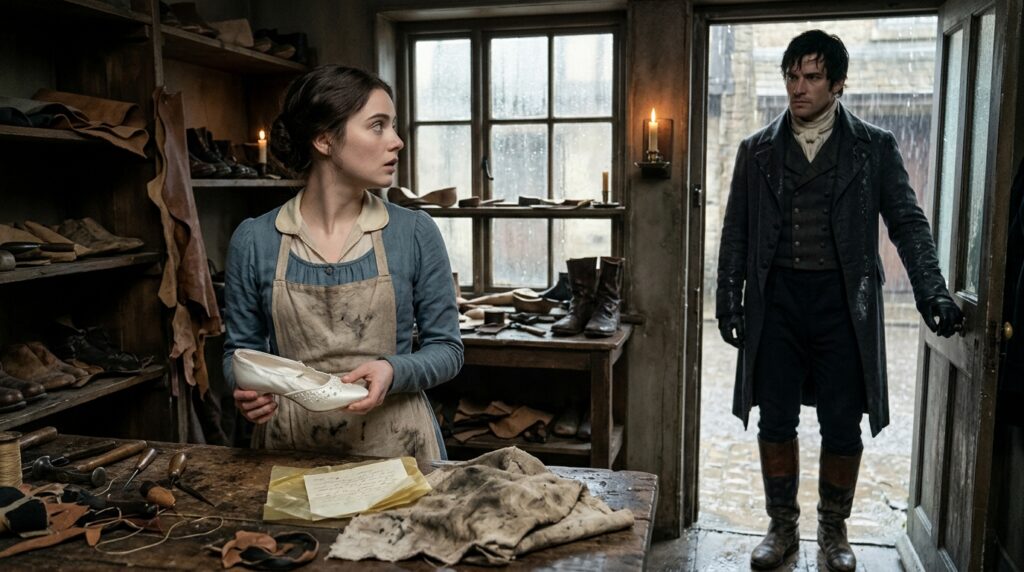
The journey north took four days. On the first day, the Duke barely spoke. Every so often he touched his coat over the place where Clara’s letter lay as though to make sure it was still there. Mrs. Dobbs talked enough for all three of them about the price of flour and the curate’s unfortunate whiskers until she fell asleep somewhere past Oxford with her bonnet over one eye. In the quiet that followed, the Duke spoke.
“Why did you not simply do as Crane asked?” he said. “Alter the shoes, take the five guineas, ask no questions. It would have been far safer.”
Nell considered the question honestly.
“Because they were my father’s best work,” she said. “Shoes like that are made for one walk, Your Grace, to carry a girl from her old life into her new one. And these had been waiting in the dark for eight years for a walk that never came.”
She looked down at her rough hands.
“My father used to say a shoe remembers the foot that was meant for it. I know that sounds foolish.”
“It doesn’t sound foolish,” the duke said quietly. “It sounds like something Clara would have said.”
“Tell me about her,” said Nell.
He told her about a little girl with wild fair hair who ran barefoot through the orchards. About their mother who died when Clara was six and how Clara crept into his room every night for a year because she was afraid of the dark. About their father’s second marriage to the gracious widowed Lady Margaret and her little daughter Cecily. And how Lady Margaret had been so gentle with her stepchildren that the whole county called her a saint.
“I was grateful to her,” he said bitterly. “I was away at school, then in London in the Lords. I used to write and thank her.”
“You couldn’t have known,” Nell said.
Nell had no answer, so she did what her father would have done. She put her hand over his just for a moment. He looked down at her hand. Then he looked at her face and something passed between them in the swaying rain-loud carriage that neither of them had words for. Mrs. Dobbs gave a tremendous snore and woke herself up.
“Was I asleep?” she said indignantly. “I never sleep in carriages. Now, where was I? Oh, yes, the curate’s whiskers.”
On the second night, they stopped at a coaching inn outside Doncaster. Near midnight, unable to sleep, Nell slipped downstairs to the parlor. The duke was there in his shirt sleeves before the low fire, frowning at one of his riding boots.
“Please don’t,” Nell said. “I couldn’t sleep either. What’s wrong with your boot?”
“The heel has come loose.”
He looked at the boot with a helpless expression of a man who had never mended anything in his life. Nell laughed. She could not help it, and then she held out her hand.
“Give it to me. My father said a bootmaker without her tools is like a vicar without his prayers.”
She sat on a stool by the fire, unrolled a small leather case of awl, thread, and brass pins, and bent her head over the boot. The Duke watched her, the firelight on her dark hair, her small, rough, clever hands, so sure and quick, the way she hummed an old country tune under her breath.
“You’re very good at that,” he said at last.
“I’m the best in Wiltshire,” Nell said without looking up. “Nobody believes it because I’m a woman, but I am.”
“I believe it.”
She looked up then. He was watching her with an expression she did not know how to read. Not cold. Not cold at all.
“There.”
Her voice was not quite steady.
“That will get you to Whitby and home. Bring it to the shop afterward, and I’ll do it properly.”
“Miss Hartley.”
“Nell,” she said. “Everyone calls me Nell.”
“Nell.”
He said it slowly, as though tasting it.
“When I walked into your shop, I spoke to you as though you were nothing. I am ashamed of that.”
“You’d ridden all night because you thought someone was stealing your sister’s shoes,” Nell said gently. “I’d have broken the bell, too.”











