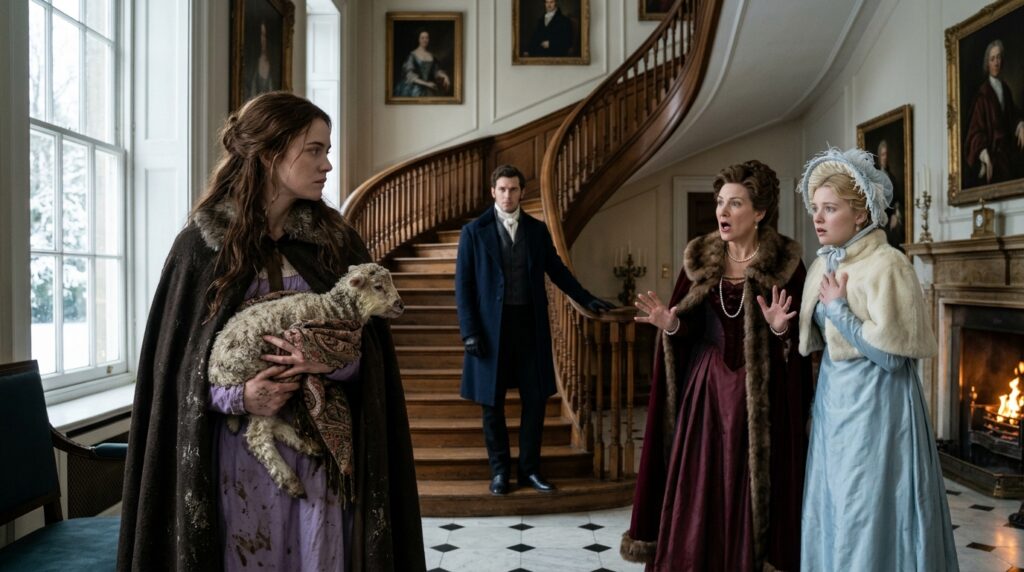
The ewe was already dead when Hester Kennesley climbed down into the ditch, and the lamb was butting at her cold side with its small, hard head, trying to make her give milk that would never come. Hester knelt in the water without thinking about it.
It was the 8th of April, 1816, and it had rained since dawn. It was the thin gray rain that blows in over the Welsh hills and settles on Hereford as though it means to stay for the summer. And the ditch beside the Kington Road was running brown and fast.
Her gown was lavender silk. It had cost 11 guineas at a shop in Hereford, and her stepmother had bought it on credit and said every day for a fortnight that it was for the day Hester met the Duke. Now it drank up the ditch water to the knee.
“Hester!”
Lady Kennesley’s voice came down from the carriage window.
“Hester, you will get back into this carriage at once. His Grace expects us at 3:00.”
Hester turned back the ewe’s ear. There was the notch at the tip of the right ear, cut out in a neat V like the tail of a swallow, and she knew the ewe then, though the face was plastered with mud and the eyes were shut.
“It’s Bramble,” she said. “She’s one of mine. Pugh must have lost her when he drove the swallowtails up to Huntington on Thursday, and she lambed here in the night, and nobody came.”
“Nobody is coming now,” said Lady Kennesley. “Put it down.”
At the other window was the face of Miss Celia Kennesley, her halfsister, who was 18 and very pretty, and had been told all her life that she ought to have been the eldest. Celia wore blue silk and a bonnet with three white feathers. She looked at the lamb and wrinkled her nose.
“It smells,” said Celia.
“So would you if you’d been born in a ditch,” said Hester, and she lifted the lamb against her chest.
He was a ram lamb, perhaps 12 hours old, all legs and wet wool. And when she put her cheek near his nose, she felt the faint warm puff of his breathing. She wrapped him in her good Kashmir shawl.
“You will not bring that creature into this carriage,” said her stepmother.
“Then I’ll walk,” said Hester. “It’s only 2 miles.”
“You will make us ridiculous.”
“I’ll make myself ridiculous, Ma’am. You may arrive on time.”
Lady Kennesley rapped on the roof, and the coachman, who had been in her service for 6 years, and knew which side his bread was buttered, drove on. Hester stood in the road with the lamb and watched the carriage go round the bend by Lyonshall church. It was not the first time she had been left behind. She found a little to her surprise that she minded it less than usual because the lamb was warm against her and alive.
She walked. The road ran along the valley of the river Arrow between orchards where the cider apples were not yet in blossom and fields where the hop poles lay stacked in gray bundles waiting for May. A carter coming the other way touched his hat to her and then stared at her hem. Ahead of her beyond Kington, Hergest Ridge lay along the sky like a sleeping animal, long and bare and brown with cloud on its back.
Every so often she bent her head and listened for the lamb’s breath. And every time she did it, she heard old Owen Vaughn saying, “Look for the breath, Hessie.” Owen had been the Kennesley shepherd for 40 years, and he had taught her everything she knew, which was a great deal more than anyone at Kennesley Court supposed. He had taught her that after a heavy snow, a sheep may lie buried in a drift for 3 days and still live, and that you will never find her by looking for a sheep. You look instead for the breath, a little hole in the crust of the snow, no bigger than a thumb, where the warm breath of the creature underneath has melted its way out, and the rim of the hole turns faintly yellow.











