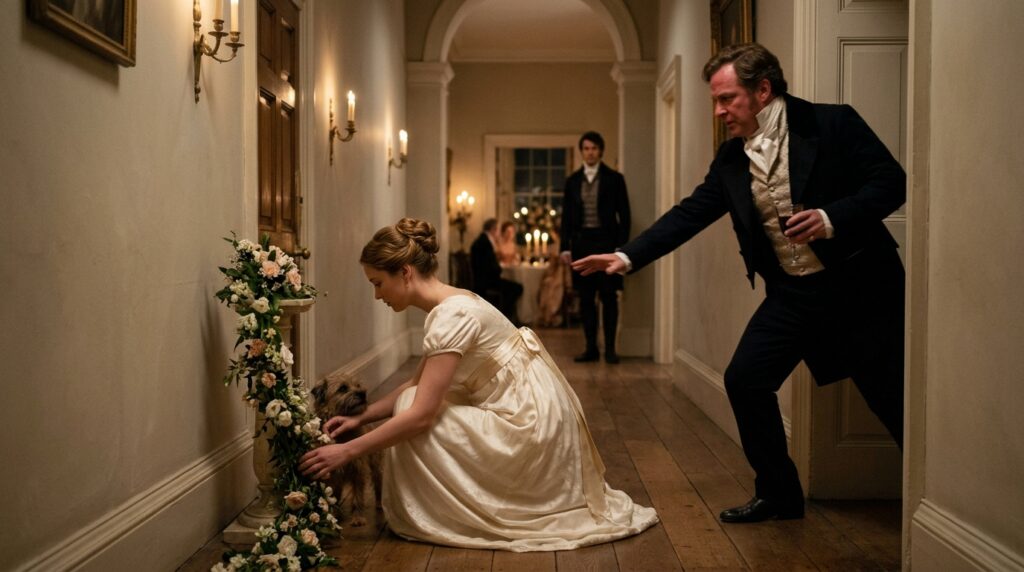
Mrs. Aldridge nodded once in the manner of a woman who had been waiting for someone to ask the right question.
The parlor maid, it turned out, had a name. It had taken Mrs. Aldridge four days and one letter to a contact in another county house to find it. Miss Ruth Carey, now working as a seamstress in St. Albans. She had left the Hertfordshire property three years before Mrs. Sutton without a character for reasons she had never disclosed.
When Vivian’s careful and honest letter reached her, she replied by return post. Her account was two pages. It matched Mrs. Sutton’s in every structural detail except the year and the room it happened in.
The footman was harder to find. He had drifted north to Cambridgeshire, working at a livery stable. Mrs. Aldridge’s network reached him eventually through a cousin of the second under-groom at Hartwell. His name was Thomas Price. He agreed to write his account down, which he had never done before, because, as he stated in his letter, nobody of standing had ever asked him to.
Three accounts now, from three people who had never met one another, telling the same essential story in their own separate words. Three different years, three different rooms. The same man, the same pattern, the same aftermath.
Dismissed without a character, scattered to different corners of the country. Each one alone too easily dismissed. Not three alone.
Vivian found a fourth through the Roads Society itself, a groundskeeper who had worked on a parish boundary project under Fenn’s supervision, and been summarily let go for alleged negligence. The negligence, on examination of the actual project records, was Fenn’s own. The man’s name was George Fielder. He was not difficult to find. He was difficult to persuade, and then suddenly easy once Vivian told him there were three others.
“Three others,” he repeated.
He had not moved for a moment.
“All with the same story?”
“Not the same,” said Vivian. “Different details. Same man, same pattern, same ending.”
George Fielder exhaled slowly.
“You tell me they won’t have to stand up alone,” he said.
“I can promise you they will not,” said Vivian. “Because I intend to be in the same room.”
While Vivian gathered testimony, Arthur went looking for numbers. He was a methodical man by nature. He understood accounts the way Vivian’s father did, not as abstractions, but as records of decisions. Lord Fenn published his charitable giving in the county notices every year.
It made for impressive reading. The Roads Society Endowment, the church at Harwick, the magistrates’ fund. Arthur set his secretary to pull 3 years of actual receipts. The discrepancy was not subtle.
What Fenn had told the county he gave and what he had actually given were separated in some years by several hundred pounds. The Roads Society accounts showed it plainly. The church at Harwick showed it plainly. Even the magistrates’ fund, which Fenn chaired, showed a pattern of announced generosity that did not on examination survive the ledgers.
Arthur brought the figures to Vivian on a Tuesday evening and laid them on the library table between them without a word. She looked at them for a long time.
“He has been paying for forgiveness,” she said, “with money he never actually spent. The reputation is built on a fiction and every man who vouched for his character based on those figures has been vouching for a lie.”
“That,” said Arthur, “is not an accusation anymore. That is arithmetic.”
It gave them, for the first time, something entirely separate from one person’s word against another’s. Cold figures, verifiable, drawn from the society’s own records. The kind of evidence that does not depend on whether a duchess is believed or a housekeeper is believed, but simply on whether two columns of numbers match. They did not match.











