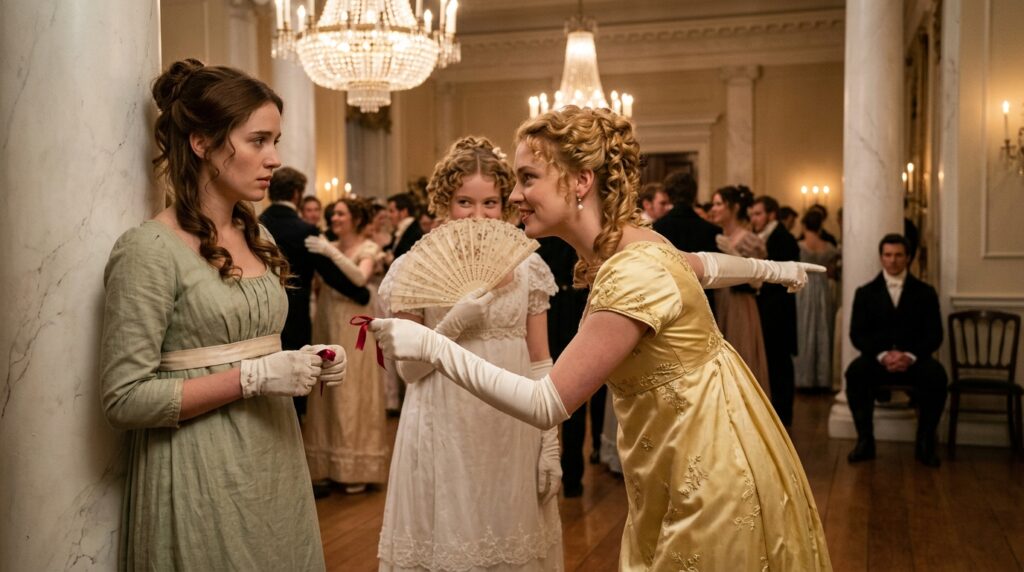
Selena carried the cherry ribbon back across the floor and put it into Blanche’s hand without a word. She did not tell her sisters what had passed. It had not been theirs. For once in her life something was hers alone. The Montley House in Half Moon Street was narrow and let for the season above the family’s means, which was the whole trouble of the Montleys in a single fact.
They spent on the front what they could not spare from the back. The drawing room was handsome. The bedrooms were cold. Selena slept in the smallest at the top where the chimney did not draw, and it was there, by one candle, that she did the work that kept her sisters looking new. She was at it before 8 the next morning.
Verity’s white gown had a wine stain on the skirt from the Alverton supper, and it was Selena’s to save. She had learned the trick from her mother in the good years before the money went. You did not lift a stain. You made it disappear. She unpicked a breadth from the back where the eye did not travel, set it in the front, and turned the stained breadth under behind.
No one at the next assembly would ever know. The needle was the one thing she was allowed to be better at than her sisters. Her thimble was silver, worn thin at the crown, and it had been her mother’s, the only silver thing Selena owned. When she was tired, or when the house was loud with Blanche’s disappointments, she would turn it on her finger and think of her mother’s hands, quick and kind, nine years in the churchyard. Her mother, Mrs. Montley, the second Mrs. Montley, Selena’s stepmother, though the word was never used aloud, put her head in at 9:00.
“You sat with the Duke of Oak Haven,” she said. She did not say good morning. “The whole of the Alverton is speaking of it. Mrs. Pool had it from her sister before breakfast.”
“Blanche dared me to,” Selena said, and set another stitch. “I dare say Blanche has told you so.”
“Blanche says you made a spectacle.”
Mrs. Montley came into the little room, which she did rarely, and looked at Selena with the particular attention she gave to a thing that might be turned to use.
“But Mrs. Pool did not say spectacle. Mrs. Pool said the Duke stood up for you twice, that he fetched you a chair with his own hands.”
Her eyes narrowed, doing sums.
“Is it true?”
“He was civil,” Selena said. “That is all. He was kinder than the room that came to gape at him.”
“A duke,” her stepmother said softly to herself, as though Selena were not there. “A duke worth £40,000 a year, and a house in every county, and he stood up for the plain one.”
She looked at Selena’s turned gown, at the worn thimble, at the candle burned down to save the wax. And Selena watched a new idea being born behind her stepmother’s eyes, and did not like the look of it.
“Well, we shall see. Do not spoil Verity’s white. She wears it Thursday.”
She went out. Selena turned the thimble once on her finger and bent again to the wine stain and told herself the whole thing was over. One strange kind evening never to be repeated. A ribbon settled and forgotten.
3 days later the Dowager Duchess of Oak Haven’s card came to the door. The Dowager Duchess did not send for Selena’s mother or for Blanche or for Verity. She sent for Selena. That alone set the house upside down for a morning.











