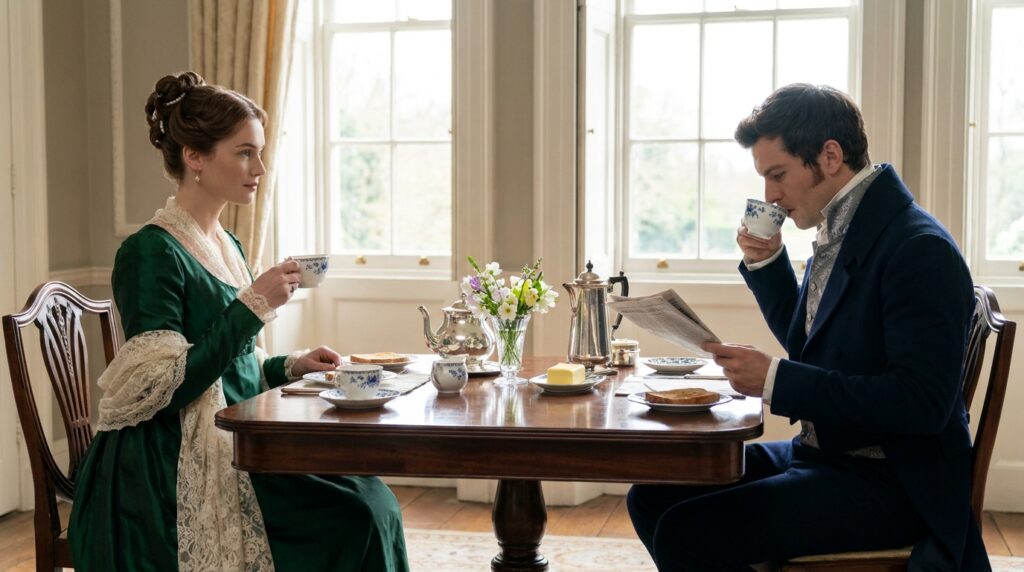
He went into the breakfast room, where the table had been cleared, and he sat down in the chair he had occupied that morning, and he tried to reconstruct what he had said. He could not. The shape of the sentence was gone from him entirely. He remembered the paper, he remembered the coffee, he remembered her asking him about the Pemberton ball, and even that he remembered only because she had asked it, not because he had attended to the asking. And beyond that, there was nothing, and the nothing was worse than any recollection could have been, because it told him in unmistakable terms what manner of attention he had been paying to her for seven years.
He went back through them now with the thoroughness of a man taking the measure of his own failure. Her arrival at Wexford House, when she had asked him whether she might make any alterations to the morning room, and he had said she might do whatever she liked. And then for three days had failed to ask her what she had done. Her first season as his duchess, when she had moved through the assemblies with a composure that had drawn comment.
And he had registered the comments as one registers the weather, and had not understood that her composure was costing her something. Her father’s death three years ago, which she had borne with the same dignity, and which he had marked by writing her a letter from his study to her morning room. Three rooms away.
He stood up. He walked into the hall. Mrs. Netherwood was descending the great stair with a basket of household linen, and she stopped when she saw him, and set the basket on the second step.
“Mrs. Netherwood,” he said.
“Your Grace.”
“I should like to know whether Her Grace seemed well.”
Mrs. Netherwood looked at him for a moment longer than was strictly necessary, and then she said with the precision she brought to all such questions:
“Her Grace was very composed, Your Grace.”
It was, he understood, an answer and not an answer. It told him that Lavinia had not wept in the hall, that she had not raised her voice, and it told him by what it did not say that the composure had been the surface of something else, and that Mrs. Netherwood was not going to discuss it with him.
“Thank you,” he said.
He sent word to Marbury, and the irony of that was not lost on him even in the moment that he was sending word to Lavinia’s sister’s husband to apologize for missing a sitting at the House of Lords because he was riding to that sister’s house to find his wife. And he climbed into the chaise, and Trelawny’s son drove, and they were on the Kent Road by 5:00.
In the second hour, he understood the magnitude of what he had said. He had used the word casually because the matter, the Pemberton ball, had been beneath the level at which he engaged his attention. The casualness was the trespass. He had answered a question about a ball with a word that addressed the fundamental status of the woman who had asked it, and the disproportion was such that no woman of intelligence, and Lavinia possessed it in measures he had only intermittently allowed himself to consider, could have failed to register exactly what the answer told her.











