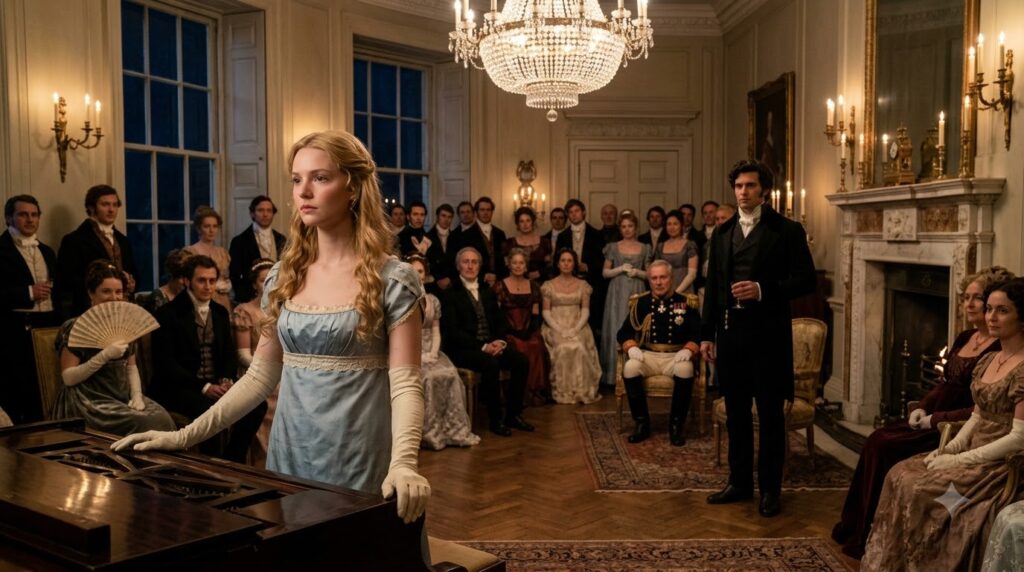
“She has the voice of a crow,” the Duke told his guests and did not lower his voice to say it.
She had expected condescension. She had expected to be seated below the salt. She had not expected to be discussed as though she were a dish that had disappointed. The music room at Kestrelmere smelled of beeswax, hothouse roses, and money too newly made to be forgiven for it. Forty guests turned to look at her.
Marianne Harkort did not turn to look at anyone. She was two-and-twenty. Her gown was blue silk. Her father had ordered it from a warehouseman he trusted more than he trusted dukes. She had been asked to sing tonight for one reason only.
The king himself had requested a song from the merchant’s daughter everyone was whispering about. She set her hand on the pianoforte’s lid. The wood was cool. Everything in this room was cool, she thought, except the blood most of them would like to see spilled.
The Duke of Ashkam stood by the mantel with his glass untouched. He watched her the way a man watches an account he expects to close at a loss. Julian Ravenscroft was 31. He was broad through the shoulders in a coat cut plain by the standards of the room. His eyes were an unfashionable amber.
They made him look absurdly warmer than he was. He had not raised his voice above conversational pitch to insult her. That was the particular cruelty of it. He had simply said the thing, as one states a fact about the weather. He seemed certain no one present would trouble to disagree.
The hostile chorus rustled its approval in silk and low laughter. Lady Prowitt’s fan moved a fraction faster. Somewhere behind Marianne, a voice murmured something about coal money and counting noses. She did not turn to find its owner.
His Majesty was seated in the room’s best chair, a plate of iced fruit untouched before him. He lifted one hand.
“I asked for a song,” he said, mild as milk. “I did not ask for a review in advance.”
A ripple of discomfort went through the room. It was quickly smoothed. The king’s mildness was its own weather system. Everyone present had learned long ago to read it.
Marianne turned the pages of the music she had not asked to bring. She had not been permitted to choose it. Her father sat three chairs back, gone the color of raw dough.
He had built his fortune in tallow and glass. He had spent 11 years buying his way toward rooms exactly like this one. He had never once considered that the purchase might include this, being told in front of the sovereign that his daughter’s voice belonged to a scavenging bird.
She did not weep. She had stopped doing that at 14, the year her mother died. Her father had told her not unkindly that tears cost time they didn’t have.
She didn’t protest either. Protest handed a man like the Duke the satisfaction of having provoked something. She sat instead at the pianoforte.











