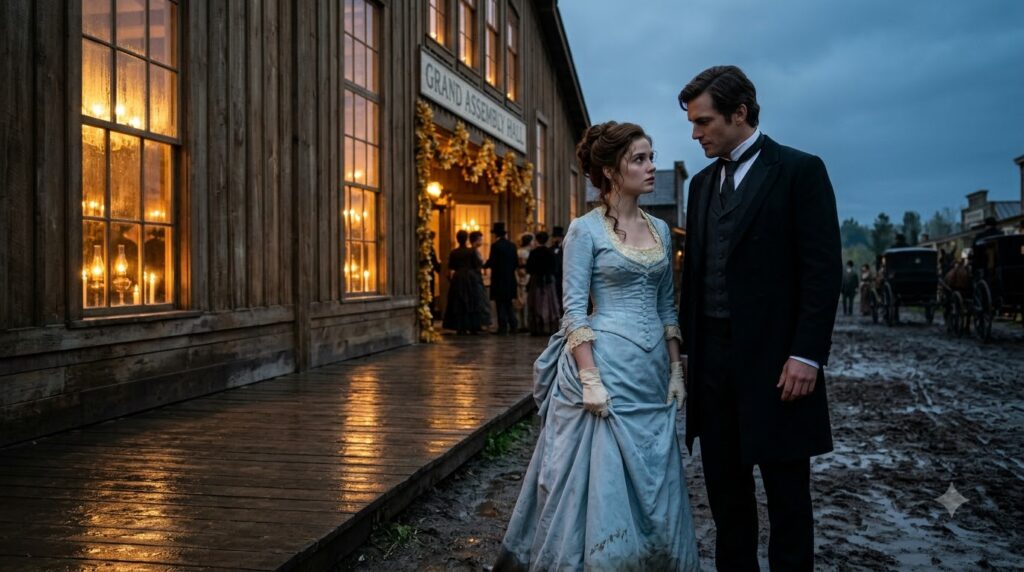
For a long moment, Rose did not move. Rain whispered across the roof of the stable awning and gathered in small puddles beneath the waiting carriage. Caleb Stone stood a few steps away, one hand resting on the open carriage door, the other extended toward her.
He did not hurry her. He did not look impatient. He simply waited.
Rose looked at his hand. It was a strong hand, browned by the sun and marked by years of honest ranch work. She had seen those hands holding reins, carrying sacks of grain, and helping elderly neighbors into wagons.
But she had never imagined that one day he would offer that hand to her. Not like this. Not when she was standing in the rain with a wet dress and a broken heart.
“Caleb,” she said at last, “you really don’t have to do this.”
“I know.”
“You must have had other plans.”
“I did.”
She lowered her eyes.
“Then I shouldn’t keep you.”
He smiled.
“Rose, you are the plan.”
She looked up sharply.
“What?”
Caleb stepped a little closer.
“I was hoping to spend the evening with you.”
The words seemed to stop the rain around her. Rose searched his face for some sign that he was teasing. There was none. He looked almost shy, despite his confident manner.
“I thought you might enjoy a dance,” he added.
Rose remembered their conversation outside the general store. Perhaps Saturday will be a good evening to remember how. She had carried those words with her for days. And now the man who had spoken them was standing before her, asking her to come with him.
“But there must be dozens of ladies at the ball,” she whispered.
“There probably are.”
“They’ll all be beautifully dressed.”
“I’m sure they will.”
“And you could dance with any of them.”
Caleb considered that.
“Perhaps.”
Then his expression grew serious.
“But you’re the one I came looking for.”
Something inside Rose softened. She had spent years believing she was the person people remembered only when work needed doing. If there were dishes to wash, they called Rose. If a seam tore, they called Rose.
If a guest needed another blanket, Rose was expected to find one. But when there was a celebration, a new dress, or an opportunity for happiness, she somehow became easy to forget. Now Caleb stood in the rain telling her that her presence mattered. Not because she could sew.
Not because she could cook. Not because she could make herself useful. Simply because she was Rose. Her throat tightened.
“I don’t know what to say.”
Caleb’s smile returned.
“You don’t have to say anything.”
He glanced toward the carriage.
“Although I might suggest we get out of the rain before both of us become too wet to attend.”
A small laugh escaped her. It surprised her. The sound seemed almost unfamiliar after so much crying. Caleb’s eyes brightened.
“There. That’s better.”
Rose looked toward the house. The windows were dark. The servants had finished their outdoor work, and the yard was quiet except for the rain and the horses. She could go back inside.
She could change into her working dress. She could spend the evening pretending she had never hoped for anything more. Or she could take the hand being offered.











