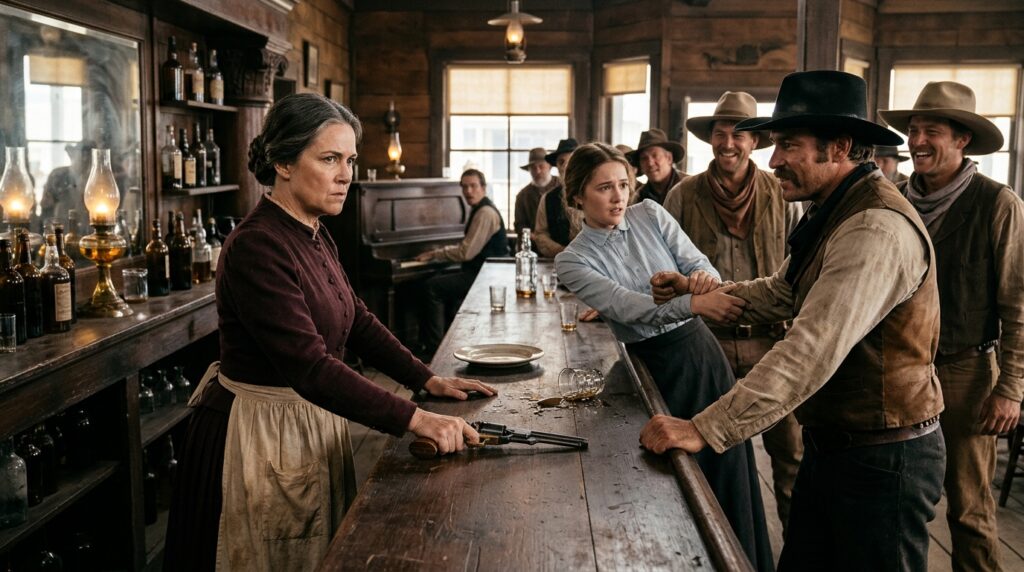
“Put that weapon down,” Deputy Vale called. His star gleamed on a coat much cleaner than the roads deserved. Behind him Pike resumed his smile, grateful that the law had arrived exactly when promised. Vale glanced at the broken fence rail, then at the bell. “Discharging a firearm within town limits. Reckless endangerment. You are under arrest, Mrs. Whitcomb.”
Ruth placed the revolver on the counter. “Pike fired first. There are witnesses.”
“I heard only the second shot.”
“Then you heard what suited you,” Clara said.
Vale ignored her. He turned to the gathering townspeople and announced that the saloon would be closed until the railroad company’s claim was resolved. Ruth asked to see his warrant. He displayed a folded page bearing the county seal, but kept it too far away for anyone to read.
Blacksmith Jonas Reed stepped inside. His heavy apron still smelled of coal smoke. “That bell means trouble,” he said. “Samuel told us to come when it rang. What trouble have you brought here, Orson?”
Vale’s face tightened. “This is official business.”
“Then conduct it officially. Show us the paper.”
The deputy’s hand drifted toward his belt. Ruth recognized that moment from three winters of fearing bad news about Samuel: the dangerous space where pride might become violence.
Clara stepped behind the bar, where the fake deed lay under spilled whiskey. She picked it up and held it toward the light. A pale impression showed through the back, as though someone had written on another sheet above it. The impressed words were not Samuel’s name. They read MERCY CREEK LAND OFFICE, followed by a date two months after the supposed sale.
Clara had found the first proof the deed was fabricated. Vale saw it too. His next order was immediate: “Burn every paper in this building.”
No one moved at first. The command hung in the saloon like smoke from the earlier gunshots. Vale seemed to hear himself too late. He amended it, calling the documents dangerous forgeries that must be seized for inspection. But Jonas Reed had heard the first version, and so had the boardinghouse women standing in the doorway.
“A marshal doesn’t burn evidence,” Jonas said.
“A deputy does what is necessary,” Vale replied.
Ruth slipped her hand over Clara’s and guided the deed beneath the counter. She knew the girl wanted to wave the paper in Vale’s face. She also knew a man who lied about lawful authority would gladly destroy the proof of his lie. “My daughter has done nothing wrong,” Ruth said. “If you must arrest someone, arrest me.”
Pike leaned against the stove and lowered his voice. “That can be arranged. Her company might improve while you’re gone.”
Ruth felt a coldness sharper than fear. It would be easier to fight him than to endure that threat without reacting. She forced herself to look at Clara instead. Her daughter understood and kept both hands visible.
Outside, the crowd had grown. Teamsters, laundresses, a schoolteacher, and two farmers stood shoulder to shoulder. Not all admired Ruth. Several owed money to High Ridge Consolidated and could lose their jobs by interfering. But they had heard the bell, and they were watching.











