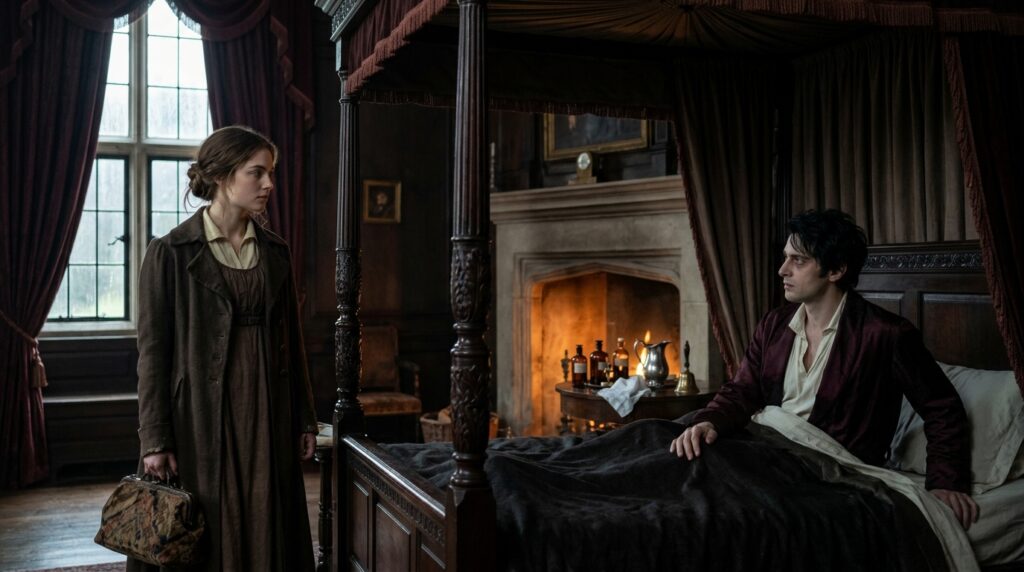
The Duke of Ashcombe had already ordered his coffin when the young woman arrived with muddy boots, a battered carpet bag, and the extraordinary impertinence to ask whether he had tried opening his bedroom windows. For 6 weeks, the shutters had remained closed against the November rain. The physicians had come and gone with their grave expressions, and everyone at Renford Hall had learned to move as though the house itself were dying.
His Grace, Sebastian Vale, was 38 years old, possessed one of the oldest dukedoms in England, and had been informed by three eminent gentlemen that he would not see another spring. He had accepted the verdict with the same cold efficiency with which he settled an account. His solicitor had been summoned, the horses assigned to suitable hands, the jewels listed, the library cataloged, and a discreet undertaker instructed to prepare a plain oak coffin.
There was only one matter his preparations had not resolved. Sebastian could not bear to die alone. It was an admission so humiliating that he had never made it aloud.
Instead, he placed an advertisement requesting the services of a respectable young lady as a companion to an invalid gentleman for a generous salary and a period not expected to exceed 3 months. 42 applications arrived. The housekeeper rejected most, the steward dismissed the rest, and only one applicant appeared in person after receiving no reply at all.
Her name was Eleanor Finch. She was 24, dressed in a faded brown coat with a missing button, and carried in her carpet bag three books, a tin of peppermint sweets, and a pair of spectacles repaired with blue thread. She had traveled 11 miles on the back of a coal cart because she could not afford the fare for a carriage. When the butler tried to turn her away, she said, very politely, that she had come to see the gentleman who was paying a stranger to watch him die, and she would rather hear from him whether he truly meant to waste his remaining days.
Thus, before breakfast, she was standing in Sebastian’s bedchamber under the horrified gaze of his valet. Sebastian watched her from the great four-poster bed, his face gaunt, his black hair disordered, his hands startlingly thin upon the coverlet.
“Who permitted you upstairs?” he asked.
“No one,” she answered. “Your stairs are rather steep, but not defended.”
The valet made a sound like a man swallowing a pin. Sebastian might once have expelled such a visitor immediately. Illness had exhausted his appetite for ceremony.
“Have you experience with the dying, Miss Finch?”
“Yes.”
Her answer came too quickly for invention.
“My mother died when I was 17. My father died 3 years later. I looked after them both.”
“And did you save either?”
She studied him for a moment.
“No, Your Grace, but neither died believing he or she was an inconvenience.”
A strange silence followed. No courtier had spoken to Sebastian in that fashion since he inherited the title at 19.
“What salary do you require?” he asked.
“Whatever sum your advertisement promised. I would also like permission to use the kitchen after the cooks have finished and to send letters without having them read.”
“You presume you have the position.”
“I presume you are tired of applicants who tell you what you wish to hear.”
Sebastian’s mouth moved almost imperceptibly. It was not quite a smile.
“You may stay for 1 week. If you annoy me, you leave without a reference.”
“And if I annoy you sufficiently to make you forget you are dying for half an hour,” Eleanor replied, “you may consider paying me a bonus.”











