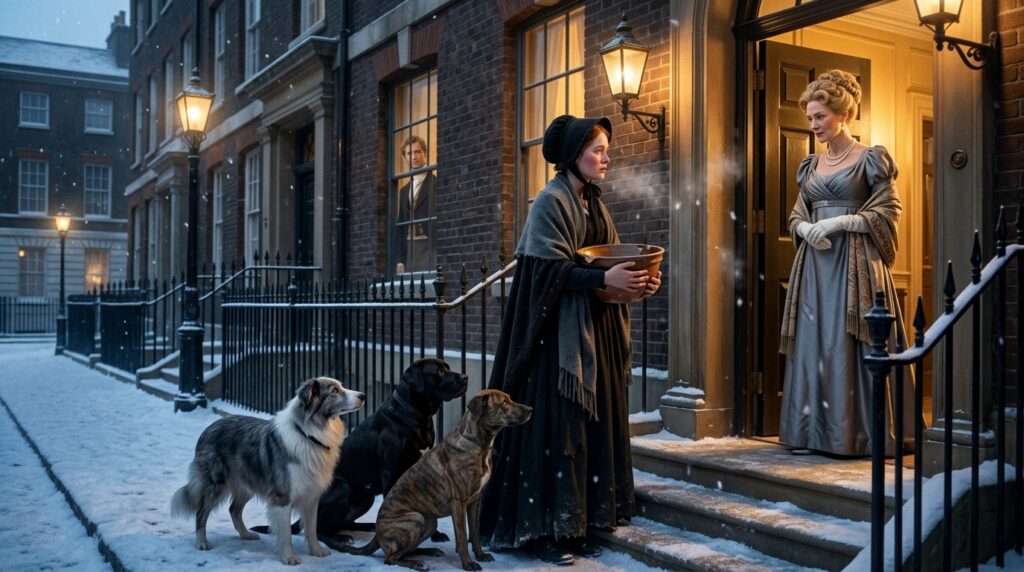
The bowl was heavier than it looked. Elizabeth Bane had carried it all the way from Devon on her knees, wrapped in her second best shawl, and now she held it against her chest on a doorstep in London, while the snow came down on her bonnet. It was a wide brown earthenware bowl, glazed dark on the inside and left rough on the outside, with a chip in the rim where her grandmother had once struck it with a rolling pin in a temper. Every loaf she had ever made had begun in it. She had left behind the chairs, the curtains, the good blue china, and her husband’s books.
She had not left the bowl. At her feet pressed close against her skirts, sat her dogs. Juno was the eldest, a moor collie with a gray muzzle and a white ruff that the snow was turning whiter still. Rook was black and broad and silent, and he watched the street the way a sentry watches a road. Bramble was the youngest, brindled and long in the leg, and she could not keep still for wondering at the carriages.
They were her husband’s dogs first. Matthew had walked the moor parish with them in every weather for years, and they had found lost ewes for half the farms below the tors. Now they were hers, and they were all she had brought out of that life, except the bowl, a small trunk, and his old writing slope. The knocker she had just let fall, was still trembling on its brass plate. It was a handsome house on a quiet square, with clipped bay trees in tubs on either side of the steps, and a fanlight full of candle glow.
The house next to it was taller and darker, and its shutters were closed on every floor but the second. Elizabeth did not look at that house for long. She knew whose it was. Everybody in Devon knew whose it was.
The door in front of her opened, and a footman in a green coat looked first at her, then at her bowl, and then, with a slow and terrible politeness, at the dogs. The Duchess of Nunthorp came into the hall herself a moment later. She was a handsome woman of perhaps 40 in a gown of dove-colored silk, so new it still held the folds of the shop, and the hall behind her was full of hothouse lilies in December. Elizabeth had met her twice before, both times in the churchyard at Falcon Lair, where the Duchess had come down from the Dower House in a carriage to be gracious to the curate.
The second time had been at Matthew’s funeral in October, when she had come all the way down from London on purpose for it, which the parish had thought very kind. She had pressed Elizabeth’s hand in her gloved one and said that if ever Mrs. Bane should find herself alone in the world, there would be a place for her in her Grace’s household. Elizabeth had written in November to take her at her word. A short reply had come back in a secretary’s hand, saying she might come after the middle of the month.











