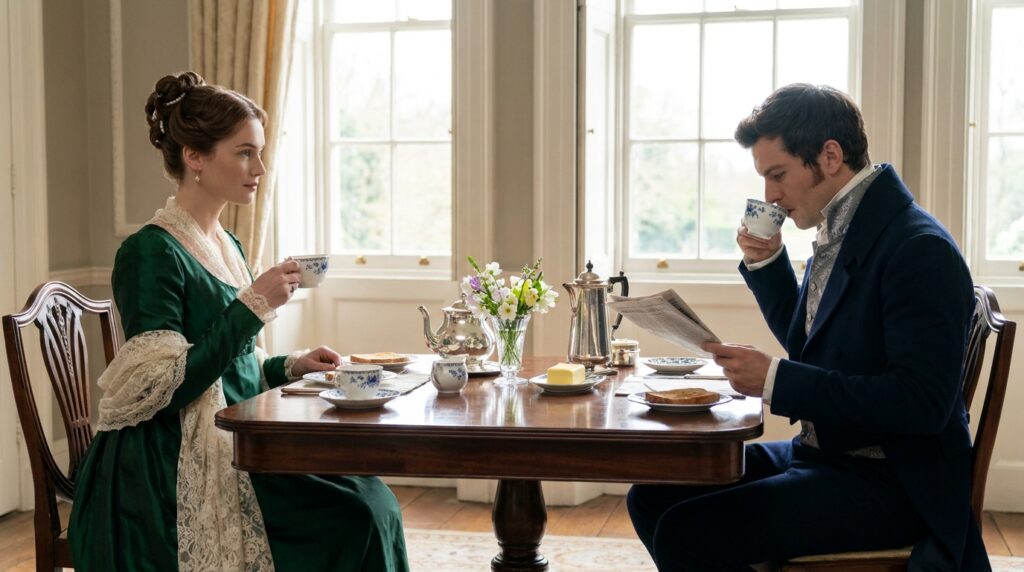
The word landed in the room the way a coin dropped onto polished wood lands, not loud, not violent, but with a small bright sound that nothing afterward could pretend not to have heard. “Replaceable.” Lavinia had been lifting her teacup. She set it down again with a steadiness that was not steadiness, but the absence of permission to be anything else. And she looked at her husband across the breakfast table at Wexford House, and Hadrian Strafford, 6th Duke of Wexford, did not look back at her. He was reading.
He had been reading the whole time he had been speaking, and the casualness of it, the way one might mention that the morning post had brought a notice from the bank or that the weather looked uncertain, was the particular wound she would carry with her into the carriage and across two counties and through the door of her sister’s house in Kent before she allowed it to be named for what it was. She’d said something perfectly ordinary, a remark about the Pemberton ball, whether they ought to accept. And he had said, without raising his eyes from the paper, that she might do as she liked, that the matter was hardly significant, that the world contained a great many women who could go to balls and any of them were replaceable by any other. And she was included.
She had not been listening for cruelty. She’d been speaking to him the way she spoke to him every morning, quietly, easily, as one speaks to a person whose presence is part of the architecture of one’s life. And the words had arrived not as a blow, but as a stone dropped from a great height onto the surface of a still pond with that strange interval between the falling and the registering of the impact. He turned the page of his paper.
He had not noticed. That was the second wound, and it arrived more cleanly than the first: that, having dropped a thing of that weight into the morning between them, he’d gone back to the news from the city as though he had said nothing at all. The saying had cost him nothing because the thinking had cost him nothing because she had cost him, finally, nothing of consequence at all. Lavinia lifted her cup again. She drank.
It was lukewarm. She placed her napkin beside her plate with the precise care she’d been taught as a girl at Lindley Park, where her mother had told her the year she came out, that a lady’s hands at the table told the world everything the world needed to know about the quality of her composure. Her mother had been dead nine years. The lesson had outlived her.
“I find I have a slight headache,” she said.
Hadrian looked up. There was in his face the faint puzzled courtesy of a man pulled from his reading by a small domestic announcement. He said something, that she ought to lie down, that she ought to send for Dr. Beckett if it worsened. And she nodded.











