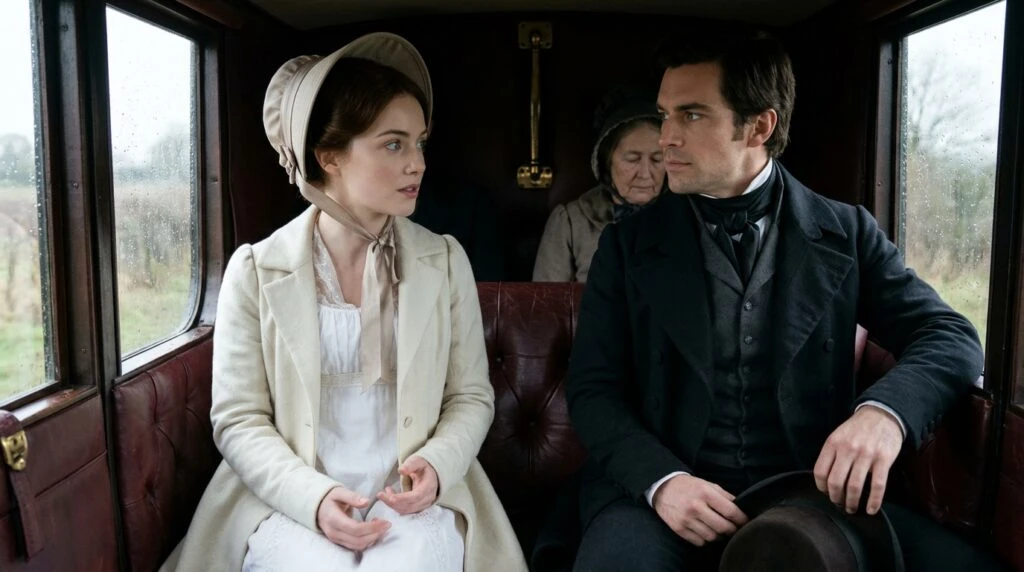
“I would rather marry a chimney sweep than a duke,” Miss Harriet Lowe declared, and the gentleman across from her nearly dropped his hat. He caught it at the last moment, an inch above the muddy straw on the floor of the mail coach, and set it carefully on his knee as though it had personally offended him. She had no idea the betrothal papers in his coat pocket bore her name. The coach lurched over a rut in the Hampshire road. Beside Harriet, a stout woman in a purple bonnet clutched a basket of eggs and made a small, scandalized sound.
“A chimney sweep, miss,” the woman said. “You cannot mean it.”
“I mean every word,” Harriet said. “A chimney sweep works for his bread. He climbs onto a roof in all weathers. He does a hard and dirty job. And when he comes home at night, he has earned his supper. A duke has earned nothing. He was simply born, which I am told is not much of an accomplishment. Even kittens manage it.”
The gentleman across from her coughed. It might have been a laugh. It might have been the damp. He was tall, too tall for the narrow bench, so that his knees had to angle sideways to avoid hers.
He wore a plain dark greatcoat and good boots that had seen a great deal of mud. His face ought to have been stern. A straight nose, a hard jaw. But his gray eyes were watching her with an expression she could only describe as fascinated.
“Forgive me,” he said.
His voice was low and pleasant.
“I did not mean to stare. It is only that I have never heard anyone compare a duke unfavorably to a kitten.”
“Then you have not met very many honest people,” Harriet said.
“That,” he said, “is entirely possible.”
The gentleman’s mouth moved at one corner.
“And what, may I ask, has a duke ever done to you, miss?”
He waited politely for a name. She hesitated. Her aunt would have fainted to know she was speaking to a strange man on a public coach, but in two hours she would never see this man again.
“Lowe,” she said, “Harriet Lowe.”
Something changed in his face. It was very small, a stillness, a flicker in the gray eyes, as if he had stepped onto a stair in the dark and found it one step lower than he expected. Then it was gone.
“Miss Lowe,” he repeated slowly, “and I am…” He paused just slightly too long. “Ash. Mr. Ash.”
“Mr. Ash,” she said, and inclined her head.
“You were going to tell me,” he said, “what dukes have done to you.”
Harriet folded her gloved hands.
“I read the newspapers, sir. They tell me that a duke may run up debts of 30,000 pounds at the tables and his tailor will thank him for the honor. That a duke may vote against a bill to stop small boys being sent up chimneys because his own chimneys are swept so very well. And that a duke may make love to a girl all season in front of all of London and then drop her like an old glove when a richer bride comes along and no one will say a word against him because he is a duke.”
The coach was quiet for a moment save for the rain and the creak of the leather straps.
“That last one,” Mr. Ash said quietly, “that was not from a newspaper.”
Harriet looked at the window.
“No,” she said at last, “it was not.”











