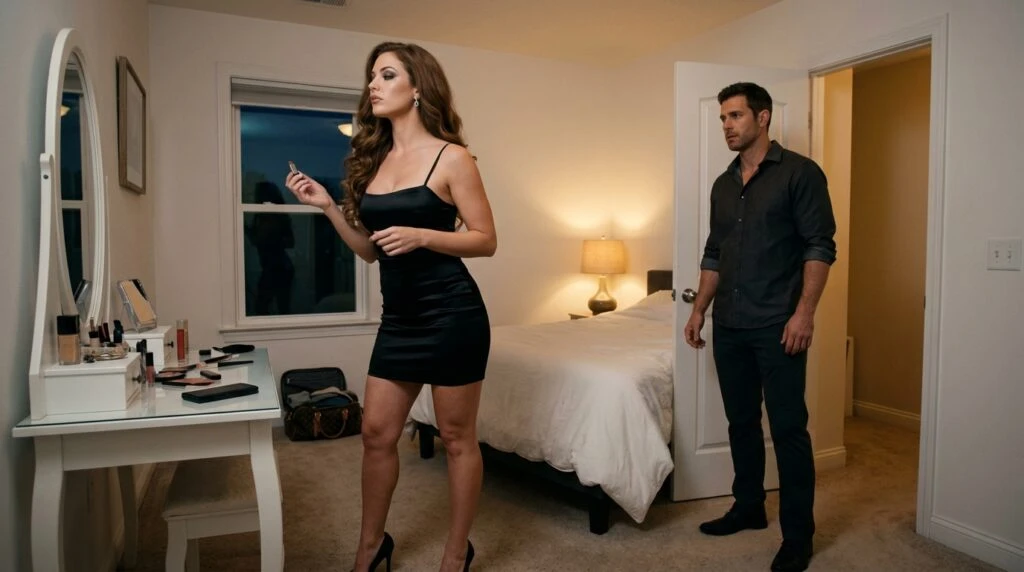
Lauren stood in our bedroom wearing a fitted black dress I had never seen before.
An overnight bag rested beneath the window.
Then she looked at me through the mirror.
“I want to try other men, Ethan.”
I waited for her to laugh.
She didn’t.
“And I’m going on a date tonight.”
Three years of marriage had just been reduced to one casual announcement.
“With whom?”
“That isn’t the point.”
“It feels like the main point.”
Lauren folded her arms.
“I married too young. I need freedom. Security isn’t the same as happiness.”
Every word sounded rehearsed.
She wasn’t asking permission.
She was informing me that she planned to date other men while expecting our marriage to remain exactly where she left it.
“So what happens to us?”
She sighed.
“Why does everything need a label?”
Then she picked up her overnight bag.
At the bedroom door, she turned back with a confident smile.
“You’ll understand eventually.”
That was when I finally understood something she hadn’t.
Lauren believed she could walk out as my wife, spend the night pursuing someone else, and return whenever she wanted.
I stepped aside.
“Go ahead.”
She smiled and walked downstairs.
But she never noticed that I had stopped asking her to stay.
My name is Ethan Walker.
I was thirty-five years old when my wife announced our marriage had apparently become optional.
Lauren was thirty-one.
We had been married for three years and together for almost six.
We lived in a two-story house outside Columbus, Ohio, with a small fenced backyard, a mortgage neither of us loved, and a golden retriever named Murphy who believed every person entering our home existed specifically to admire him.
From the outside, our marriage probably looked boring.
I used to think that was a compliment.
I worked as an operations manager for a medical-supply company.
Lauren was a marketing coordinator at a regional software firm.
We took one decent vacation every year.
Had dinner with my sister twice a month.
Argued about thermostat settings.
Watched crime documentaries neither of us actually followed because we spent half the episode talking over them.
There had been no dramatic betrayal that I knew of before that night.
No lipstick on a shirt.
No hotel receipt.
No mysterious second phone.
The change was slower.
About six months earlier, Lauren started talking about how she had “missed experiences.”
At first, I thought she meant travel.
She had married me at twenty-eight.
I was thirty-two.
Neither of us was exactly a child.
But Lauren started describing her twenties as though we had met when she was sixteen and locked her inside a farmhouse.
“My friends got to date.”
“So did you.”
“Not really.”
“You had three serious boyfriends before me.”
“That’s not the same.”
“Same as what?”
“Exploring.”
That word appeared often.
Exploring.
Freedom.
Independence.
Identity.
They were not bad words.
That was what made the conversations difficult.
It is hard to object when someone wraps dissatisfaction in healthy vocabulary.
If I said marriage involved commitment, Lauren said I was afraid of growth.
If I said I thought we were happy, she asked whether happiness should mean never changing.
If I asked whether there was someone else, she became offended.
“You always reduce everything to cheating.”
I had asked exactly twice.
Still, according to Lauren, always.
So I tried to listen.
I suggested counseling.
She said counseling would make “normal questions about identity feel pathological.”
I suggested we travel more.
She said travel was not the point.
I asked what she needed from me.
She said:











