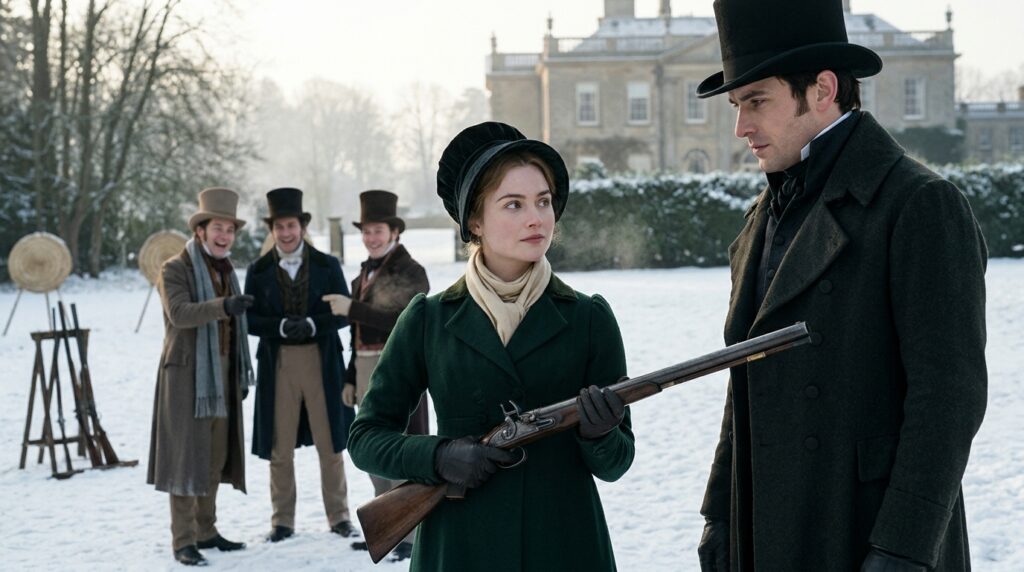
On the morning of the 17th of November, 1817, the gravel before Brinkburn Castle lay white with frost. The breath of the gentlemen smoked in the air. The spaniels whined at the keeper’s heels, and the guns waited on a trestle under the great gray walls, like a row of polished walking sticks. It was the first day of the Duke of Brinkburn’s shooting party, and every guest in the house had come down to see the sport begin. Miss Ruth Armstrong came down last, and she came because she was sent.
Old Lady Lumley, who hated the cold more than she hated anything except fools, had kept to her bed and dispatched her companion with a message. The Duke was to be told that her ladyship wished to hear the day’s bag at dinner, and that she expected it to be respectable. Ruth delivered the message to the keeper, since the Duke was still upon the steps, and turned to go. She did not get far. Lord Devereux, who had dined beside her the evening before, and found her a great joke, stepped into her path with a smile that showed all his teeth.
“The oracle herself,” he said, so that the whole sweep could hear him, “Lady Lumley told us at dinner that her companion knows a good lock from a bad one. Gentlemen, we are honored. Miss Armstrong has come to inspect our guns.”
There was laughter, the easy laughter of men who are warm inside their coats and have slept well. Lord Devereux drew something from his pocket with a flourish. It was a lady’s fan, painted with roses, and Ruth recognized it as Miss Beresford’s, for Miss Beresford was laughing on the steps behind her muff.
“Give her a fan, not a gun,” said Lord Devereux, and he pressed it into Ruth’s hand. “Far more suitable. Though if she is truly so fond of powder, she may carry the flasks, and welcome. My man has a cold.”
The laughter rose again. Ruth stood quite still in her plain dark green wool, the fan in one hand, and felt the color climb her throat. She did not look at the gentleman. She looked, without quite meaning to, at the top of the steps.
The Duke of Brinkburn stood there in a dark blue coat with gold buttons, his face as unreadable as the frost. He had seen everything. He said nothing for a long moment, and then he said, in a voice that carried without being raised:
“Miss Armstrong may do exactly as she pleases.”
“Then I will carry the flasks, Your Grace,” said Ruth. “Somebody must, and I at least shall not spill them.”
She tucked the fan into her sleeve, took the powder flask and the shot belt from the keeper’s hands, and walked out behind the guns with her chin up and her cheeks burning. Nobody offered to take the flasks from her, and she would not have let them. She could not know it then, but by the week’s end those same gentlemen would stand in silence on the wet lawn of Brinkburn, watching a plain woman in green lift a rifle to her shoulder. And the Duke of Brinkburn, who had said so little that morning, would say a great deal more than any of them wished to hear.











