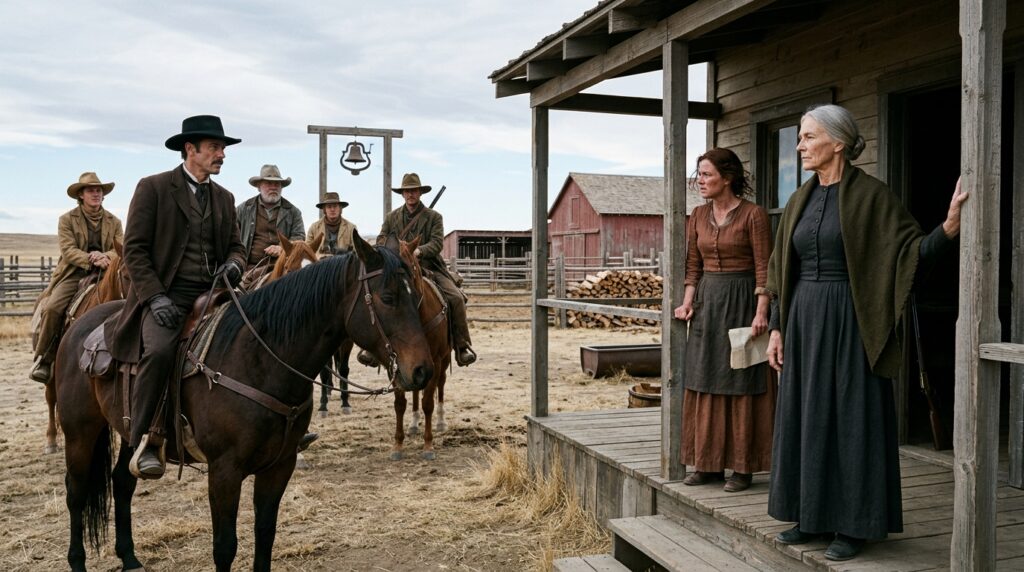
Peter led them to his aunt’s boardinghouse, where the three examined the ledger page by candlelight. The payments were larger than Nora expected. Granite Crown had paid officials not merely to move one boundary, but to acquire every spring and creek crossing along the freight road. The company planned to build a private water station and charge settlers for access. Families who could not pay would be forced to sell their claims. Peter admitted he had copied several pages before the ledger was moved. He had kept them hidden because he feared losing his clerkship and being accused of theft. Eleanor did not praise him for waiting. She asked why he had finally decided to help. Peter said his father’s homestead lay downstream from Nora’s spring. The company had already sent a notice claiming his family owed a fee for water they had used for twenty years. Nora understood then that Samuel’s refusal had not been a private quarrel. He had stood between the company and an entire valley. Peter produced a second paper, a list of planned evictions. Beside Nora’s name was a date: Friday. Beside the name of Peter’s father was the same date. The company intended to move quickly before anyone could file an appeal. Eleanor folded the list.
At the boardinghouse, Peter’s aunt served coffee and asked no questions until the door was locked. She had watched officials come and go for twenty years and knew when a visitor carried trouble. The copies were smudged, but the dates and amounts remained clear. Nora wrote the totals in the margin. The sum was enough to buy several farms, yet the company had spent it to make lawful owners believe they had no rights. Nora waited. Eleanor listened.
“Then we will make certain the valley knows before Friday.”
They began with the families who lived along the creek. Nora rode to each ranch and showed the copied entries, never leaving an original behind. Some people believed her immediately. Others feared the sheriff and refused to be seen with her. An old German couple said they had already been offered money to leave. A Black homesteader named Josiah Bell showed them a notice claiming his well had been built on company land, though he had dug it himself before Granite Crown existed. Josiah had kept his own records: receipts for tools, a hand-drawn map, and a letter from the previous county surveyor. Eleanor recognized the surveyor’s seal. It supported Josiah’s claim. The company had not simply changed Nora’s boundary; it had been altering records across the valley. Nora asked Josiah to testify. He agreed, but warned that his barn had been watched for two nights. On their ride back, they found a fallen tree across the road. A second rider waited beyond it. He wore no company badge and carried no papers. He told Nora that her mother had made enemies before and that old debts had a way of returning. Eleanor recognized his voice. His name was Caleb Voss, once a deputy in the territory where she had testified against Gideon Marsh. Voss smiled. “You should have stayed retired, Mrs.











