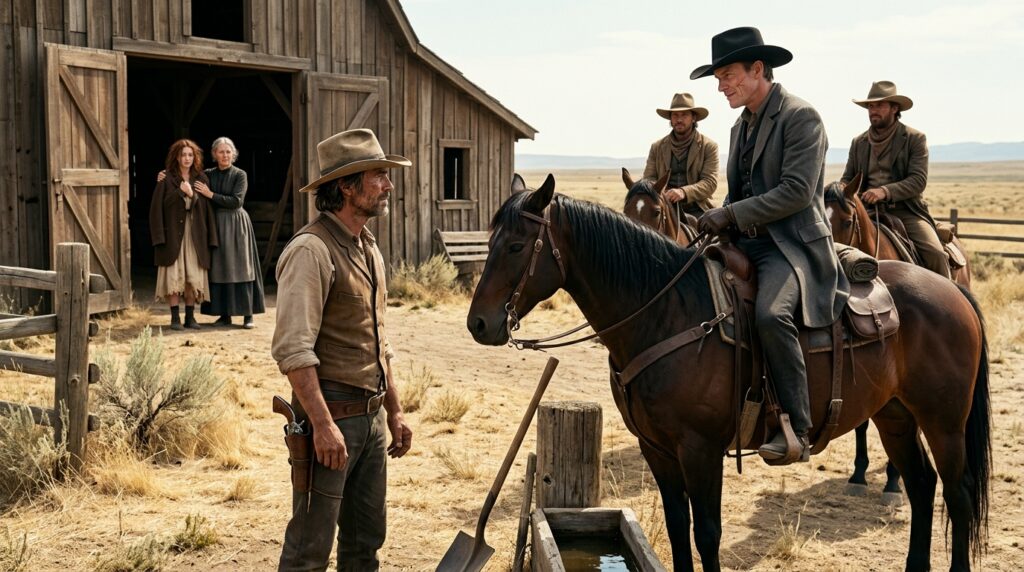
One of the riders behind Voss snorted. Wrong call. Voss didn’t turn, but the sound died immediately. Voss leaned forward in the saddle.
“You don’t have the full picture,” he said.
Cole nodded once.
“You’re probably right,” he agreed. “So, let’s ride into town and tell it to someone who can sort it out properly.”
Something flickered across Voss’s face. Just barely there, but present.
“No reason to pull the town into a family matter,” he said.
Inside the barn, a boot shifted on the wood floor. Clara was still listening. Cole moved one slow step sideways, placing himself directly between the riders and the barn door.
“Then I’d suggest you turn those horses around,” he said, “before this gets considerably louder than you came prepared for.”
Voss studied him now, taking real stock of him. An older man, hands relaxed, eyes steady with no fear worth measuring. That troubled him more than a drawn weapon would have. Without a word from Voss, one of the hired men dropped off his horse and moved toward the barn at a quick stride. Cole moved first.
Not explosive, precise. He grabbed the handle of a long shovel leaning against the fence post and brought it down in a sharp arc. Caught the man clean across the wrist. Metal on bone. The knife hit the dirt.
The second man came in from the right. Cole turned into it, absorbed the blow across his shoulder, then drove his elbow back hard enough to send the man stumbling into the water trough. The pain fired up his arm sharp enough to remind him his body hadn’t stayed 20. Water sprayed. The horse sidestepped.
Dust billowed. Voss didn’t move. He watched. He was the kind of man who spent other people first and only committed himself when the numbers looked right. Then, deliberately and without hurry, he let his hand settle onto the grip of his gun.
Cole saw it. He didn’t draw his own, because the moment that happened, there was nothing left worth saying. And somewhere just behind him, a young woman was barely breathing, waiting to find out what kind of man Cole Hargrove actually was when things reached the edge. So, the question wasn’t whether Voss would draw.
The question was whether Cole would act first or wait one breath too long. Cole didn’t pull iron, not yet. His hand stayed near the gun, but his eyes stayed locked on Voss. Men like Denton Voss were built for exactly this kind of standoff. They needed the other man to flinch first.
It justified everything that followed. Cole had watched that game play out across two years of war. Young men with fast hands and clean consciences who believed speed made them righteous. It hadn’t.
It just meant they stopped being wrong a little sooner. Voss let the silence stretch. Then slowly his hand came off the grip. Just an inch, not retreat, an invitation to believe it was finished.
“You’re turning a small thing into something it doesn’t have to be,” he said.











