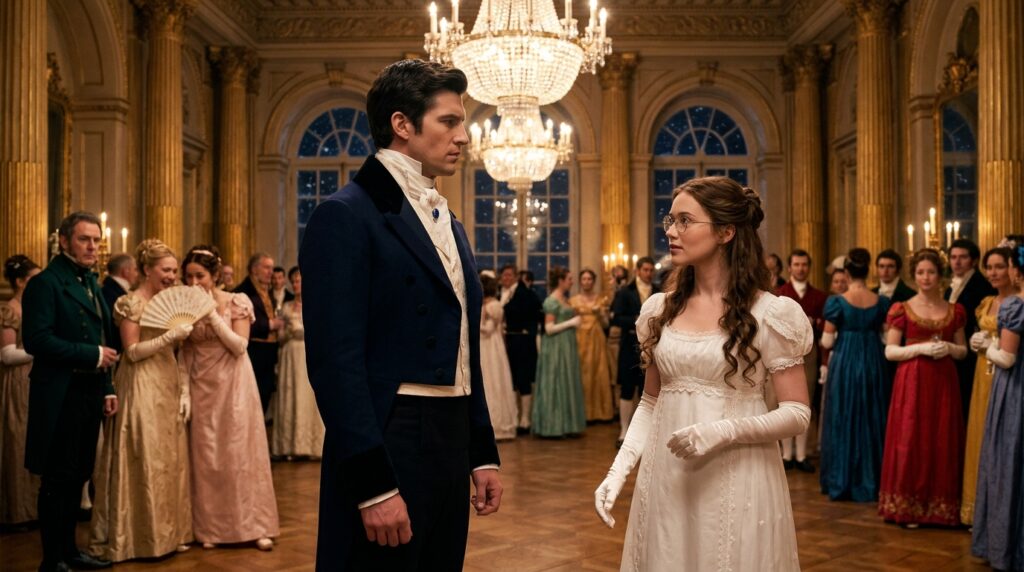
She lay awake until the candle guttered out. And the next morning, in the middle of a snowstorm, a black carriage drew up before the Ellsworth house. Adrian Whitlock stepped down from the black carriage. Snow settled on the shoulders of his heavy cloak and on his leather gloves.
Up and down the street, the people of Weatherford watched from behind their curtains for a wealthy duke calling on a moneylender’s family was a rare sight in any town. In the drawing room, Rosalind and Cecilia waited in their finest gowns arranged on the sofa like two portraits. Edwin stood beside the fireplace trying very hard to look like a man who received dukes every week. Margaret had been ordered to stay in her study.
“Stay there,” her father had said. “You will only be in the way.”
Adrian entered, bowed with perfect correctness, and did not smile. He did not compliment the sisters’ beauty. He made no attempt at romance of any kind. He came directly to the point.
“I require a wife within the month.”
He explained what he could offer. A title, a great house, a generous allowance, and a secure place in society. He could not promise flowers, love poems, or tender words. He did not possess those things, he said, and he would not insult a lady by pretending otherwise. Rosalind glanced at Cecilia. Then both of them began to laugh.
“Your Grace,” Rosalind said, “is that a proposal, or are you purchasing a horse?”
Cecilia giggled behind her fan.
“A horse wearing a bonnet.”
Adrian’s expression did not change.
“I am not a warm man. I am merely an honest one.”
Rosalind did not stop. She declared that she would rather marry a fish than a man who did not know how to smile. Cecilia added that she would rather marry an old soldier than live in a castle with an icicle. The sisters collapsed against each other in laughter. Edwin went as pale as chalk. Adrian inclined his head.
“Then I shall not waste any more of your time.”
He walked out into the narrow hallway, his jaw tight. He had 30 days to save his estate, and the two young women he had assumed would welcome his offer had just mocked him to his face. He was already calculating the miles to the next town, the next family, the next humiliation. At that moment a door opened beside him. Margaret stepped out in her plain gray dress, her brown hair pinned in a simple knot, her spectacles pushed up into her hair, a quill pen still in her hand. She stood squarely in front of him.
“I hear you need a bride.”
Adrian stopped. From the drawing room, the laughter died at once. Margaret went on.
“You need a wife, and I need a home where I am not invisible.”
She told him, as plainly as if she were reading from a ledger, that she could keep accounts, write letters in three languages, and run a household of 50 servants. She did not need flowers or poetry. She had never received either and did not expect to start now. She was not as pretty as her sisters, she said, but she was honest.











