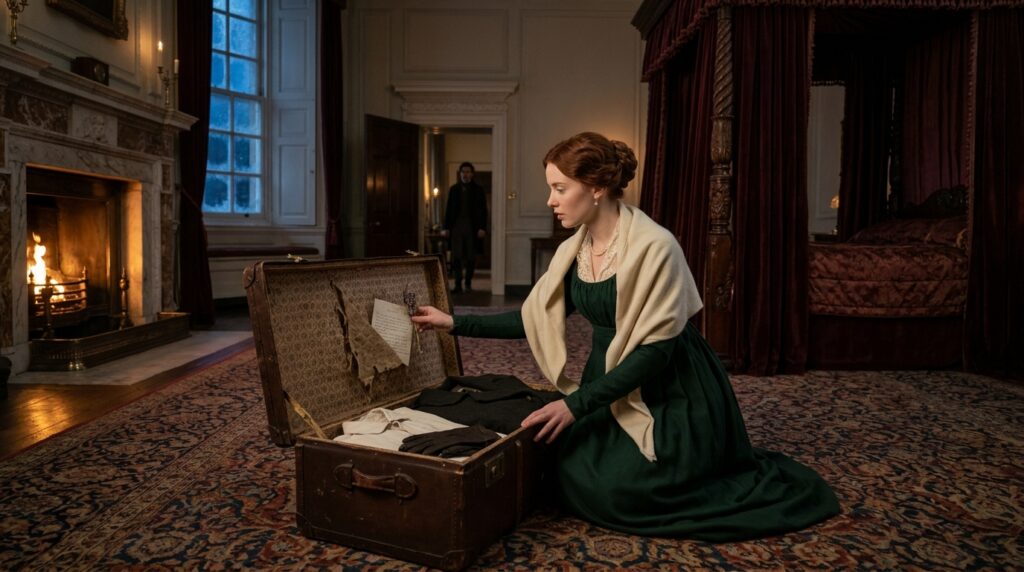
The snow kept falling, thick and relentless, and Nathaniel did not return. Eleanor used those quiet days to examine every record from the autumn and the early weeks of winter. She did not force her way into his private rooms or turn the household upside down. She simply did what she had done for 7 years, which was to read the books. This time, however, she was not searching for a way to cover the shortfalls.
She was searching for their cause. She compared three sources against one another: the main ledger of expenses, the receipts from merchants, and the payments that had actually been made. Some of the figures refused to agree. Small gaps, insignificant one by one, slowly formed a clear pattern. Money had left the estate’s funds under familiar names, but the goods it was meant to buy had never arrived.
Isaac Turner, who oversaw the daily work of the estate, came to give his report on the winter stores. There was enough firewood. The wheat was properly stored, but the repairs to the mill had been delayed, Turner said, because the bill had not been paid. Eleanor looked up sharply.
According to the main ledger, money for those repairs had already been released. She asked him to bring her the papers and he explained that the millwright, Isaac Calloway, was still waiting for his payment. A troubling connection began to take shape in her mind. If the repair money had been recorded as spent, but the man who did the work had never received it, then where had it gone?
Calloway arrived at Blackthorn Hall on a bitterly cold morning, stamping snow from his boots and holding his hat in his hands. He brought a bill for 32 pounds for necessary repairs. Eleanor examined it carefully. The amount matched the sum already entered in the ledger as payment for mill equipment, yet the description in the ledger did not quite match Calloway’s bill.
She did not leap to a conclusion. She copied every detail, noted every date, and kept the documents safe. A secret only becomes evidence when the scattered pieces are joined with precision and Eleanor intended to join them without a single mistake.
Nathaniel’s carriage returned as dusk settled over the hills. He strode into the great hall with snow on his shoulders, looking tired but pleased, and announced that the trip had been a success. Over supper, Eleanor asked him a few gentle questions about Leeds. He answered them smoothly, naming streets and men and meetings. Then, in the same mild tone, she mentioned a merchant in York.
For an instant, Nathaniel went still. His knife paused above his plate. He asked why she was interested. Eleanor replied that she was reviewing the payments. Nathaniel gave a light laugh.
“You always take numbers far too seriously.”
Then he turned the conversation to the weather and the state of the roads, but Eleanor had seen it and that small hesitation told her more than an hour of his answers had.
That night, Nathaniel slept soundly. Eleanor sat alone in the study with a single candle burning and two documents on the desk before her, each bearing the same sum. According to one, the money had been paid. According to the other, a working man was still waiting for it. Outside, the wind pushed snow against the glass.
She understood now that these numbers might lead her to a truth even crueler than the letter in the trunk. And to face that truth properly, she needed to know something she had never thought to question. Did Nathaniel actually have the right to use that money at all? The answer lay in the documents drawn up before their wedding, and Eleanor resolved to read them.











