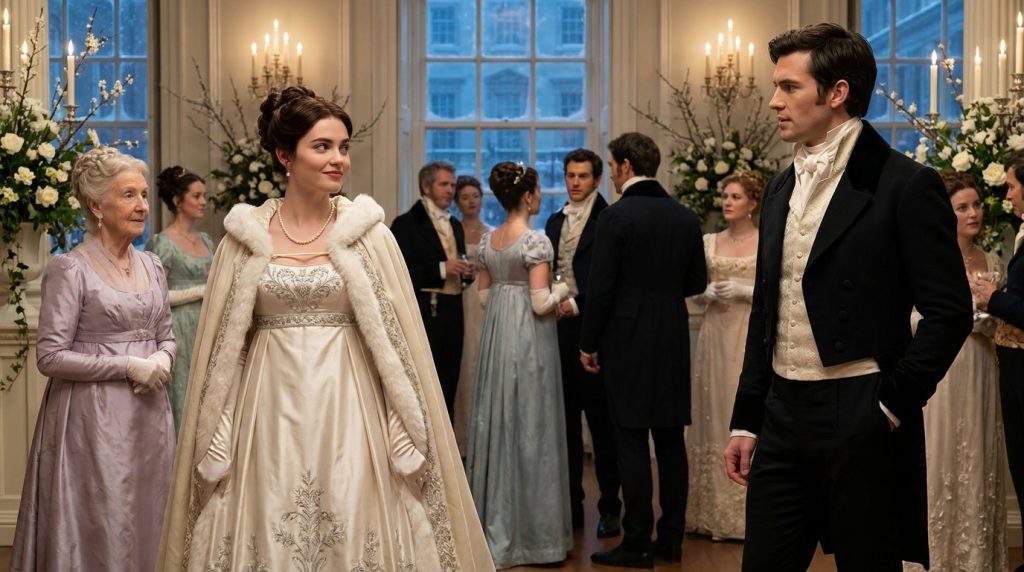
She did not want that. She wanted, just for an hour, to see what kind of man her father’s promise had tied her to. And she could not, she found, walk away from a broken thing that could be mended. So she untied her cloak and laid it over a chair and set her basket of primroses down on the window seat.
“Send someone to Covent Garden,” she said. “Not to the hothouse men, to the country women at the back of the market, the ones with the baskets. Tell them you want blackthorn. Branches of it in flower, as many as they have. Primroses with their roots on, in moss. Catkins, pussy willow, wild daffodils if anyone has brought them up from the west. And ivy. You have ivy on the garden wall behind the house. I saw it from the area steps. Have your men cut it in long ropes.”
There was a short silence. A footman coughed. The duke looked at her a moment longer, and then he took a purse from his waistcoat on the chair and threw it to the tallest of the footmen.
“You heard her?” he said. “Take the gig. Take two men. Buy what she said.”
Then he turned back to Branwin.
“Blackthorn,” he said. “In a ballroom.”
“It is the first thing that flowers in March,” she said. “Before the leaves. It looks like snow that has decided to stay in candlelight. It will look like nothing your guests have ever seen in London.”
Something moved at the corner of his mouth. It was not a smile. It was the place where a smile had been a long time ago.
“Then we will give them something they have never seen,” he said, and he went back up his ladder to the window.
The next three hours were the strangest of her life. The blackthorn came back in the gig in great white armfuls, a little battered by the wind, and the primroses in shallow flats of moss that still smelled of some far hedge. Branwin worked with her sleeves pushed up and her hair coming down, and nobody in that house thought to wonder who she was, because she was too busy to be wondered at. She sent the bruised camellias down to the kitchen to be cut short. Then she floated their good centers in wide silver bowls of water, so that the brown edges sank out of sight and only the perfect hearts showed.
She had the great urns filled with blackthorn branches as tall as a man. She laid the primroses along the deep window seats in their moss. Now the whole length of the room looked out at the windy gray square through pale yellow flowers, like the cottage windows at home looking out through the hedges. And she had the ivy wound round the pillars and along the musicians’ gallery, loose and trailing as it grew on the old chapel at Porth Carrow.
He did not leave the room. She had expected him to go away and let the servants manage, as great men did. Instead, he finished the window with the glazier, and then he came down and carried urns with the footmen. When the tallest urn would not stand straight on the uneven floor, it was the duke who lay on his side on the boards in his shirtsleeves and wedged a folded card under its foot. Branwin watched him do it, and something in her went quiet.
Her father had done exactly that with the table legs at Silvercourt every time a new table came, swearing cheerfully at the carpenter. They talked while they worked. It began with the flowers. He wanted to know why the primroses must go in moss and not in water, and she told him. He wanted to know how she knew blackthorn from hawthorn when neither had a leaf on it, and she showed him the bark and the thorn and the way the flower sat close against the bare wood.











