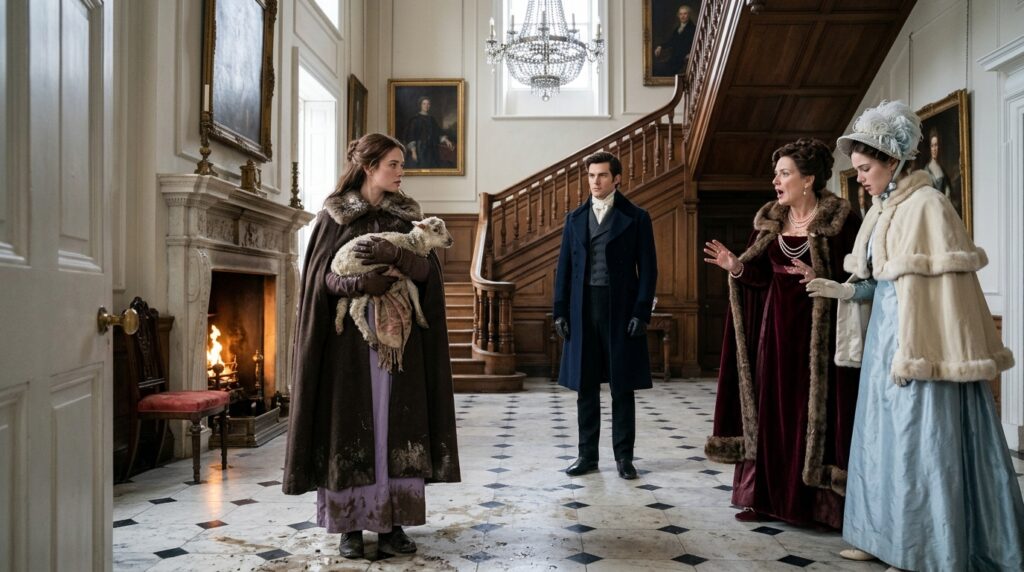
Mr. Bampton, the attorney, was a dry little man with spectacles, who had been reading wills for 40 years, and was not easily surprised. But even he looked twice at the lamb, which Hester had brought up from the kitchen in its basket, because it would not settle without her. They sat in the library, Hester in an old gray wool gown of her own from her trunk, Lady Kennesley and Celia on the sofa, Lady Harriet very upright in a chair by the fire, and the Duke standing at the window with his back to the rain. On the table in front of Mr. Bampton lay a box of plain oak about the length of a man’s arm, with a seal of red wax across its lid. Mr. Bampton read in a flat voice
“To the eldest daughter of Sir Ralph Kennesley of Kennesley Court the sum of £5,000 settled upon her to her sole and separate use with Mr. Bampton and the dean of Hereford as her trustees and the oak box that Mr. Bampton holds for her. She will know why.”
He took off his spectacles and explained, because Lady Kennesley was already leaning forward with a gleam in her eye, that by the law of England, everything a woman owned became her husband’s on the day she married, unless it had been tied up beforehand by trustees for her alone, and that the late Duke had tied up this money so tightly that neither a husband nor a father could ever touch a shilling of it.
“£5,000,” said Lady Kennesley faintly.
“She will know why,” said Lady Harriet from her chair. “My brother was a great one for riddles in his last weeks.”
“And there was a request,” said Mr. Bampton, “made by the late Duke to his son in my presence 3 days before his death, that His Grace should offer marriage to the same lady. It is not a condition of the will. His Grace is quite free. But he gave his word.”
“I gave my word,” said the Duke from the window without turning round. “And I will keep it. Miss Kennesley, I have the honor to ask you to be my wife.”
It was the coldest proposal Hester had ever heard of, and she had read a good many in novels. She looked at his back and at the rain on the glass beyond him, and she thought, “He is offering for me the way a man pays a bill.”
“Thank you, Your Grace,” she said. “I’d like time to consider until the 1st of May, if you’ll allow it.”
Lady Kennesley made a sound like a kettle. Celia stared, but the Duke turned from the window at last and looked at her, and something in his shut face eased very slightly, as if he had been braced for a blow that had not come.
“Until the 1st of May,” he said. “Open the box, Miss Kennesley.”
She broke the seal with her thumbnail. Inside, folded very carefully in linen that had gone yellow with age, lay a small coat. It was a boy’s coat made of blue wool, the sort of coat a lad of 14 or 15 would wear to go about the farm. It had been darned at one cuff with gray thread. Down the front were five buttons of plain horn, and where a sixth should have been, there was only a little tuft of torn threads.











