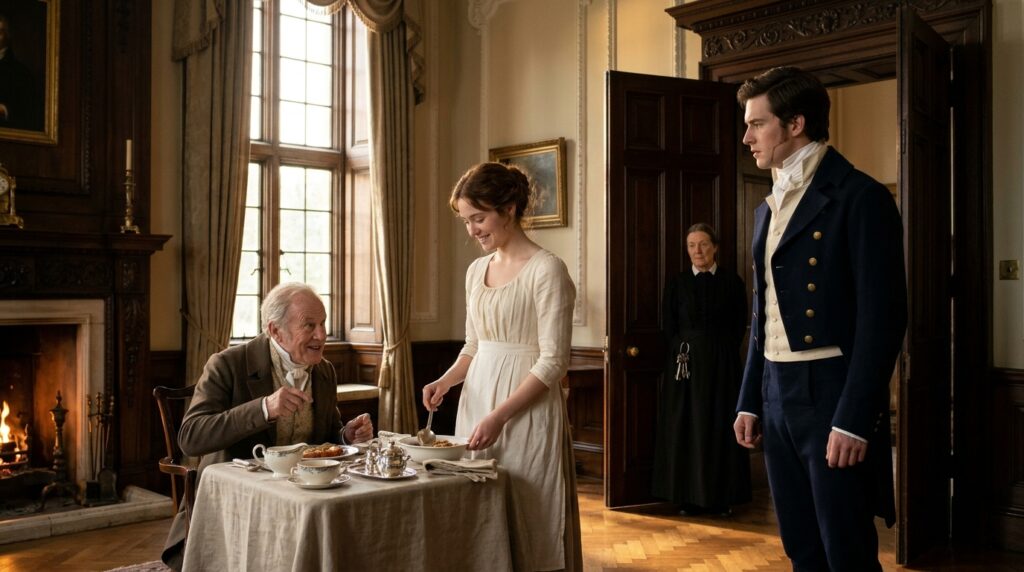
That would be Elm Knoll. Everyone in Wiltshire knew the story, even the cooks in Devizes. He had gone into the ranks off the down, and in Spain they had made him an officer for his courage, which hardly ever happened to a shepherd’s son. After Waterloo, the Prince Regent had made William a duke for what he had done that day, and Parliament had given him money to buy a house fit for the title.
The title was new. It had not come down to him from anybody. His father had never been anything but a shepherd, and William had bought the biggest house he could find within sight of his father’s chimney. And his father would not climb the hill to live in it.
The cottage door was shut. No smoke came from the chimney. Sarah knocked twice. When nobody answered, she lifted the latch and went in.
It was dark inside and cold, colder than the lane. The shutters had been left half closed. The hearth was gray with old ash, and a few sticks smoldered at the back of it without any real heat. On the table stood a covered dish with a cloth over it.
And when she lifted the cloth, she found a slice of cold mutton gone hard at the edges, and a heap of boiled potatoes that nobody had touched. Beside the dish lay a big old Bible with a cracked leather spine. And beside the Bible, in the chair by the dead fire, with a blanket over his knees, and his great knotted hands lying open on top of it, sat Nathaniel Gauntlett. She would have known him anywhere.
And she hardly knew him at all. He had been a broad man. A man whose voice could carry across a whole valley to turn a flock. Now his shoulders had fallen in.
His cheeks had sunk. His white hair stood up as though nobody had told him it needed combing. But the eyes that looked at her out of that wasted face were still sharp. And they were not pleased.
“I suppose he sent you,” the old man said.
“Good morning, Mr. Gauntlett,” said Sarah.
He looked at her without a word. She saw him place her slowly the way a man finds a tune he once knew.
“Quillgrove’s girl,” he said at last. “The cook’s daughter at the rectory. You sang in that kitchen. And the whole lane used to stop to listen.”
His mouth twisted.
“He told me last night it was you. I didn’t believe him. I thought he was trying to make me laugh.”
“Did it work?”
“No.”
He pulled the blanket higher.
“You may go back and tell His Grace that I am perfectly well. And do not need feeding like a sick lamb. I have managed my own dinner for 70 years.”
Sarah did not argue with him. She had not come to argue. She took off her bonnet and hung it on the peg by the door, where a faded woman’s shawl still hung that nobody had moved since the winter. She opened the shutters. And the gray morning came in and showed her everything.











