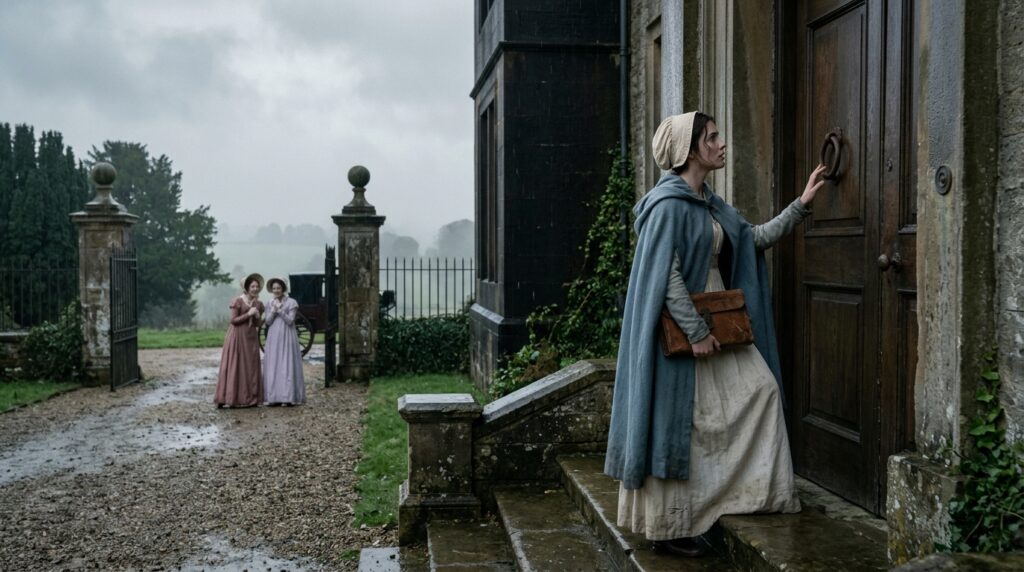
She thought afterward that if he had shouted, she would have known exactly what to do. She stood on the top step with her mouth a little open. Then the sky came down behind her with a noise like coal going into a cellar, and she stepped over the threshold of the most feared house in Derbyshire, and the door groaned shut. It was a far smaller room than she had expected to find in such a place.
A fire burned in it, and a low table stood by the fire, and on three sides the walls were books to the ceiling. He took the kettle from the hob himself. She watched him warm the pot and unlock the caddy and measure the leaves, all with a slow exactness, as if this were the one small ceremony of his day. He spoke to Josiah without turning his head.
“There are two young ladies at the gate. Take the carriage down and an umbrella. Convey them home.”
The old man’s eyebrows moved a quarter of an inch, and he withdrew. Some minutes later, through the streaming glass, she saw the Duke’s black carriage go down the drive. She thought of Charlotte, seeing it come out of the mist toward her, and had to look into her cup.
He gave her the cup himself. It was the best tea she had ever tasted, and she had not known until then how cold she was. He sat down across from her, stretched out his long legs, and shut his eyes.
“Read it to me.”
“Your Grace, it is addressed to you. I wrote it so that it could be read.”
“I don’t doubt it. Read it.”
She unfolded the letter and read it and heard how it sounded in that quiet room with the rain against the window. It was a good letter, and it told him about a woman of 71 and the kettle she had put on. When she had finished, he had not moved, but he was no longer resting. He opened his eyes.
“Who told her to go?”
She looked at him. She thought for a moment that it was a joke of some terrible kind.
“You did, Your Grace.”
She took the notice from her case with the black seal broken across it. He looked at it and did not put out his hand.
“Read that too,” he said.
So she read it in the voice she had used in Mrs. Wildgoose’s kitchen. The voice she kept for these. It took less time than swallowing.
When she looked up, the room had altered, though nothing in it had moved. The fire ticked. He sat with his hands on the arms of his chair, and all the blood had gone quietly out of his face.
“Her husband carried me on his shoulders,” he said. “At the sheep washing when I was 6 years old. He died the winter of the great snow. I said she was to have that house for her life and pay nothing for it. I said so in this room.”











