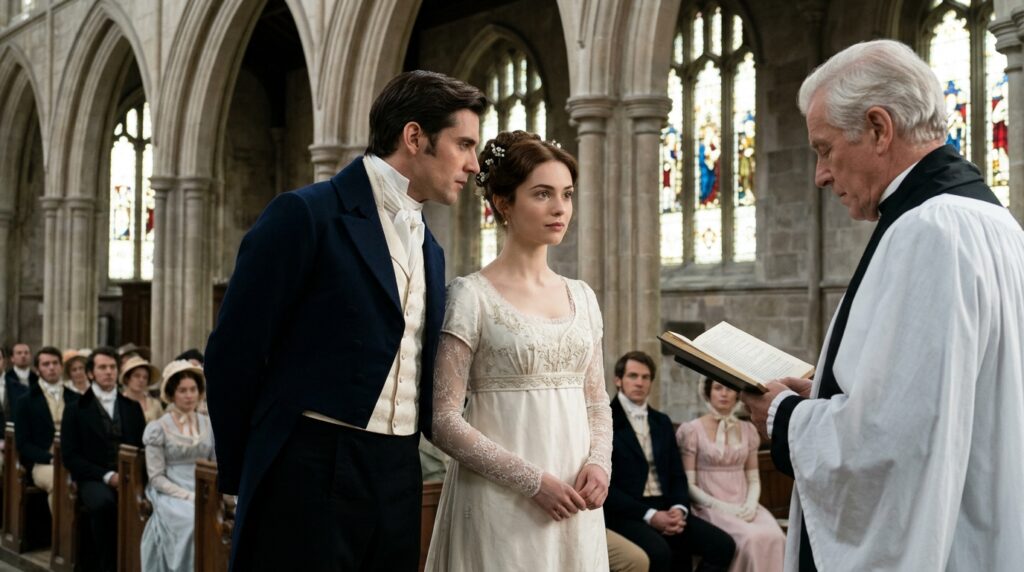
He crossed the room, not toward her, but toward the writing desk. He placed both hands flat on the surface and stood with his head bowed for several seconds. She could see the tendons in the backs of his hands. She could hear his breathing settle from rapid to controlled, and she recognized the shift because she had performed the same negotiation with her own body every day of her life.
“My mother chose you,” he said without looking up, “because she said you were sensible.”
“I am sensible.”
“Sensible women do not stop their own weddings.”
“Sensible women stop them before the wrong vows are made. Correcting an error after it is sworn before God is considerably more difficult than correcting one before.”
He lifted his head. Something had changed in his expression. The fury was still there, but it had thinned. Beneath it, she saw the thing she had noticed once before at the dinner when he had spoken about drainage reforms. It was the quick, restless intelligence of a man who had been given very few opportunities to use it against an equal.
“You realize,” he said, “that if we do not return to that church, this marriage does not happen. Your father loses everything. Your sisters lose everything.”
“Yes.”
“And you are still sitting there.”
“Yes.”
He straightened. He pulled the chair from the opposite side of the desk, sat down facing her. And for the first time since she had met him, looked at her not as a transaction, but as a person.
“Tell me your conditions,” he said.
She told him. She spoke for 4 minutes without interruption. She had clearly thought about every word before this day, because the conditions arrived in order, precisely stated, without repetition or excess. She wanted her own rooms, not banishment, but privacy. She wanted access to the library and permission to continue her studies.
She wanted her father’s living replaced, not with charity, but with a proper benefice arranged through the bishop’s office, so that Matthias Bryce might keep his dignity. She wanted her sisters provided for modestly, not lavishly, with small dowries that would allow them choices. She wanted a voice in the management of the household. She wanted, when they appeared in public together, to be introduced as his wife and not his acquisition. He listened.
He did not interrupt. When she finished, he sat in silence for a full minute. She let the silence hold because she understood that he was not deciding. He was deciding what it meant that he wanted to.
“The benefice,” he said finally. “I will write to the bishop this week.”
“Thank you.”
“Your sisters’ dowries of 400 pounds each.”
“300 will do. We are not greedy.”
He looked at her sharply, and something moved at the corner of his mouth that was not quite a smile, and was certainly not displeasure.
“300 then. The library is yours whenever you wish. The household: we will discuss that after you have seen the house. I will not promise what I do not yet know you will want.”
“That is fair.”
“And when we appear in public,” he said, and his voice had changed, quieter now, stripped of the formal distance he had maintained since their first meeting, “you will be introduced as my wife because that is what you will be.”
She stood. He stood. They regarded each other across the writing desk in the vestry of St. Bartholomew’s. The distance between them was 3 feet. The distance between what this marriage had been 30 minutes ago and what it was now could not be measured in any unit she knew.











