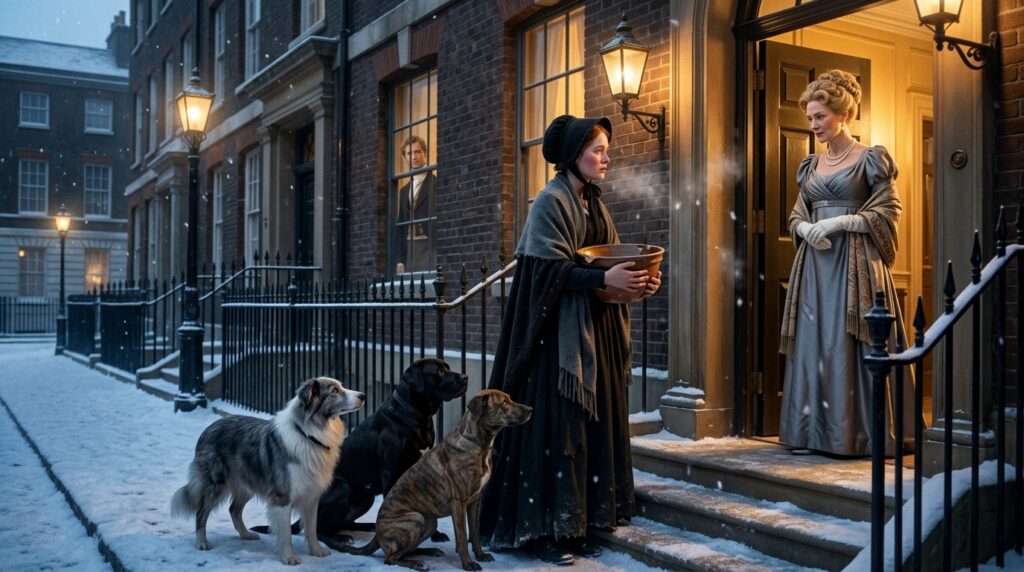
Harry Nunthorp had been standing at the window of his study for most of that afternoon. He had seen the young woman in black go up his sister-in-law’s steps with an earthenware bowl in her arms and three dogs at her skirts. He had seen the door close on her. He had not expected to see her again. Then an hour after dark, she came back across the square in the snow.
The old dog with the white ruff left her side, came to his railings, sat down, and looked up at him. He stood very still with his hand on the cold glass. He had seen a dog like that once before in snow in the worst light of his life, and he had spent six years telling himself that he had not seen it at all. He did not ring for anybody. He went down the stairs himself and drew back the bolts of his own front door, which nobody had knocked on since the autumn, and opened it on the snow.
He was a tall man, bare-headed in a dark coat, with hair of a sandy fair color that looked almost white in the lamplight and eyes so dark that she could not tell where the color ended. Elizabeth had imagined him many times. She had imagined somebody coarser. He looked at her at the bowl, at the black dog and the brindled one, and last of all at the old dog sitting on his step.
“Bring them in,” he said.
“Your Grace, I would not wish to impose on you. I only stopped because she did.”
“It’s snowing,” he said. “Bring them in.”
He stood back from the door. Juno got up stiffly and walked past him into the hall as if she had lived there all her life. After a moment, Rook followed her, then Bramble, and then Elizabeth, because there was nothing else in London left to do. The door shut behind her, and this time she found she did not mind the sound. The kitchen of that house was the warmest room she had been in since Exeter.
It was low and long with a range that glowed red behind its bars and copper pans hanging in a row that nobody seemed to have used for a long while. A broad, slow woman of about 50 came out of the scullery with her sleeves rolled up and stopped dead at the sight of the dogs. Her name was Bertha, the Duke said, and she kept his house, and she was a Devon woman. Then he said nothing else at all.
Bertha looked from her master to the young widow and back again. And some question passed across her plain red face and was answered without a word. She took the bowl out of Elizabeth’s arms and set it on the table as though it were made of glass. Then she brought a pot of tea, a heel of bad bread, and a basin of water for the dogs.











