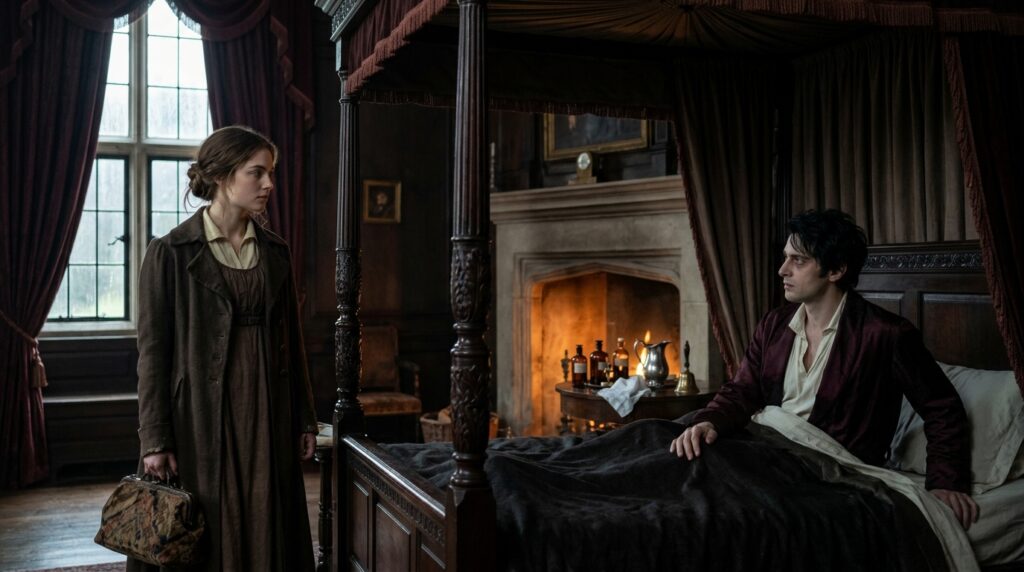
One evening, Crowther stopped her outside the library.
“You have become very interested in matters beyond your employment,” he said.
“His Grace pays me to keep him company,” Eleanor replied. “There is rather more to a man than the room where he sleeps.”
“You are a clever girl. Clever girls sometimes forget that reputation is easily lost.”
She felt his threat like a cold hand at the back of her neck.
“And dishonest men sometimes forget that figures can be checked,” she answered.
The steward smiled, but not with his eyes. Afterward, she sat by the kitchen fire longer than usual. She feared what would happen if his new hope were destroyed.
That night, the pains came again. Sebastian doubled over with a cry that seemed dragged from somewhere below speech. His skin turned clammy. His hands cramped, and for a terrifying moment, he could not tell Eleanor his own name.
The household physician, Dr. Markham, arrived near midnight. He examined the duke and spoke softly of decline. He ordered another dose of the familiar medicine and advised that the patient remain in darkness. Eleanor watched the preparation with increasing unease.
“What is in that bottle?” she asked.
“A restorative,” said the doctor curtly. “It has been prescribed for months.”
“May I see the formula?”
“Young woman, you are not qualified to question my treatment.”
“I am qualified to notice that His Grace is worse after taking it.”
The room went still. Sebastian, pale and barely conscious, lifted his eyes toward her.
“That is enough,” said Dr. Markham. “You will leave the room.”
Eleanor did leave, but not before she had seen Crowther standing behind the physician with an expression of unmistakable alarm. In the passage, she leaned against the wall and waited for her hands to stop shaking. A physician’s authority carried enormous weight in a house such as Renford, and she knew she risked dismissal for questioning it. Yet, there was something worse than dismissal: obediently watching a man die while a question went unasked.
Eleanor traveled to town before sunrise to consult an elderly apothecary who had known her father. He listened to her account, warned her that symptoms alone could establish neither a diagnosis nor a crime, and urged her to obtain an independent physician rather than alter any medicines herself. He recommended Dr. Amelia Hartwell, who had studied difficult cases abroad. Eleanor wrote to her immediately.
When she returned to Renford, Crowther was waiting with the news that her employment had been terminated. She packed her few possessions and wrote Sebastian a note asking him, whatever he thought of her, to seek a second opinion. As she reached the front hall, he emerged leaning heavily on a cane.
“Crowther says you wish to leave,” he said.
“Crowther says you dismissed me,” she replied.
He looked at her carpet bag and understood. They sat in the morning room while she showed him the copied receipts and described the tenants’ grievances. She told him what she knew about his illness and, more importantly, what she did not know. Sebastian listened without anger.











