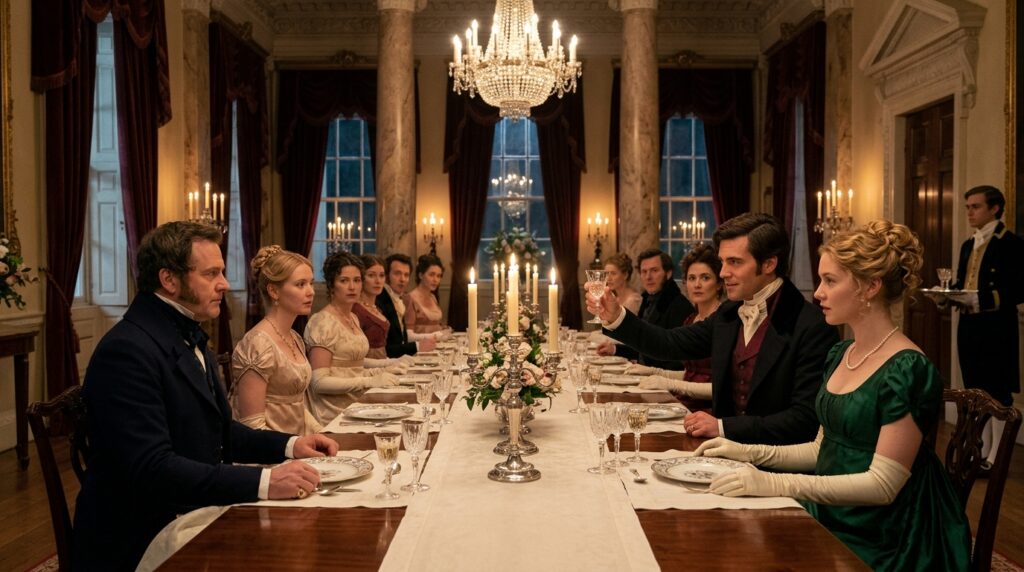
A thin mist lay over the gardens. The grass was silver with frost. They hurried down the lane dragging the trunk, their breath rising in white clouds until they saw the dark shape of a carriage waiting under the old oak trees. Samuel, the young groom, jumped down and lifted the trunk as if it weighed nothing.
“Quickly, Your Grace,” he said, “the road to the north is clear.”
They climbed inside. Samuel snapped the reins and the carriage rolled forward with a jolt. Eleanor looked back through the small window. Harcourt Hall stood tall and dark against the pale sky, its hundreds of windows empty and cold. She had arrived there at 19, full of hope.
She had spent 7 years trying to make it a home. She expected to cry. Instead, she felt something lighter, like a heavy coat sliding from her shoulders. Then far behind them a bell began to ring.
Margaret gripped her arm. “They have found out.”
“Perhaps,” Eleanor said, “but we are already at the gates.”
The carriage thundered through the great iron gates just as the first golden line of sunrise cut across the hills.
Samuel urged the horses faster. The wheels rattled over the stones and the hall shrank behind them until it was only a shadow in the mist. Edmund would wake soon, with a pounding head and a lost wife. He would read her letter.
He would see the list of debts in her neat handwriting and he would understand that she had known all along. Eleanor leaned back against the seat and closed her eyes. For the first time in 7 years, no one was waiting to tell her what she was.
Bath welcomed Eleanor with pale golden stone, busy streets, and an aunt who opened her arms before the carriage had even stopped.
“My dear girl,” said Aunt Beatrice, holding her tightly, “I have waited a very long time for this letter.”
Within a week, Eleanor had a small sunny room overlooking a garden and a stack of books on her bedside table. Within a month, she had something she had not known for years. She had mornings that belonged to her.
Meanwhile, back in Yorkshire, the news ran faster than any horse. The guests from the dinner told the story in drawing rooms across England, and each version made Edmund look worse. By the end of the first week, invitations to Harcourt Hall stopped arriving. By the end of the second, his closest friends were crossing the street to avoid him.
Then came Monday. Lord Henry Collins arrived at the hall at exactly 10:00 carrying a leather case. He asked very politely to see the account books. Edmund opened the strongroom, searched for the right papers, and realized with a sinking feeling that he had never understood any of them. For years, Eleanor had kept them in order.
Now, he could not find a single page he needed. Her letter lay open on his desk. Every word in it was correct. Lord Henry read the list of debts slowly, one line at a time. Edmund’s face turned from red to white.











