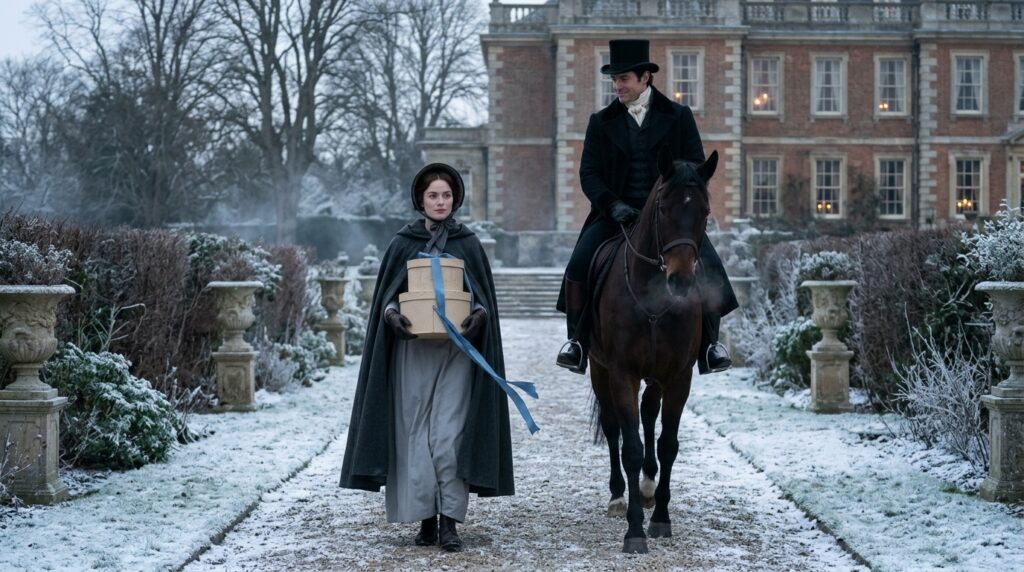
The morning after the ball dawned clear and cold, scattering pale December sunlight across the breakfast table. Verity came down twenty minutes before ten, expecting only servants replenishing the silver chafing dishes, and found a dozen guests helping themselves to toast, kippers, and marmalade. Her small leather sketchbook was tucked into a deep pocket of her dark green wool pelisse, and she had left her bonnet, scarf, and winter gloves on the cloakroom bench for a walk after breakfast. Beyond the windows, snow lay along the terrace balustrade, with a freshly swept path leading toward the garden. Before she could choose a chair, Hugh rose from the center of the table and set aside his estate letters.
“Good morning, Miss Bellamy,” Hugh said, drawing out the vacant chair to his left, while the dowager Lady Linton on his right paused with her teacup halfway to her lips. “You are just in time to save me from an argument with Mr. Hollis about whether my grandfather ruined the south view when he planted the yew hedges in 1782.”
Mr. Hollis, a cheerful country magistrate with silver sideburns, chuckled across the damask cloth.
“I only said they shelter the peaches from the wind, Your Grace, though if Miss Bellamy has an eye for gardens, I yield the floor to her.”
“I would never quarrel with a peach tree, sir,” Verity said as she took her seat and accepted the cup of coffee a footman poured for her. “My objection yesterday was not to the hedges themselves, which are very fine and thick, but to the gravel path that pretends to lead to the water, and instead delivers the walker straight into the kitchen courtyard behind the laurel bank.”
“You see, Hollis,” Hugh said, a spark of lively satisfaction in his gray eyes as he passed Verity the butter dish. “She discovered the flaw in 5 minutes from a moving carriage, whereas I have walked into the laundry carts twice a month since I was a boy, and merely blamed my own sense of direction.”
Before Verity could reply, Lydia entered on Aunt Ruth’s arm in a pale rose morning dress beneath a soft wool shawl. Three rows of lace edged her cuffs, which Verity had pressed the previous afternoon before going out to collect the delayed boxes. Lydia looked immediately toward the head of the table, expecting an empty chair near Hugh. When she saw Verity already seated beside him and the remaining places farther down between two married Yorkshire cousins, a crease appeared between her brows.
“Good morning, Your Grace,” Lydia called out in her sweetest voice, pausing just behind Hugh’s chair so he rose politely to bow to her. “I hope the fatigue of hosting such a brilliant ball did not disturb your rest. I told Aunt Ruth that the music was quite the finest we have heard all year and I am certain you must have chosen every air yourself.”
“You give me far too much credit, Miss Lydia,” Hugh replied with easy civility, motioning for the footman to draw out chairs for her and Mrs. Bellamy farther down the board. “My bandmaster chooses the tunes and I merely pay the fiddlers and stay out of their way. Have you tried the honey from the home farm? It is down near your aunt’s elbow.”
Lydia smiled brightly though her glance flicked sideways toward Verity’s plain green wool pelisse as she moved away.
“How early you rose, Verity,” Lydia added before sitting down. “Did you forget that we meant to sort my green silk ribbons before the morning walk?”
“They are in the top drawer of your dressing table, Lydia, sorted by width,” Verity answered calmly, spreading a thin layer of marmalade on her toast. “I finished them before I came down as the morning was too fine to spend indoors.”
Aunt Ruth looked up from her plate with mild surprise for Verity usually waited in Lydia’s dressing room until 11:00 to fasten the tiny pearl buttons at the back of her sister’s walking pelisse. Lydia opened her mouth as if to remind her of the buttons, then caught the Duke watching the exchange, and quickly turned to her Yorkshire neighbor with a remark about the sunshine.











